Connemara Sheep

I took these pictures of Connemara sheep recently. This is a typical sight here – the sheep often feed and rest near the roadside because the tarmac surface is warm. They wander freely and graze on what they can find among the bog grasses. This one ( below) has just noticed me.


Photo of a sheep 1


This ram is giving me the eye because there are lambs around..


Photo of a sheep 2


How rugged and handsome these weather worn creatures seem in relation to their East coast cousins who appear plump and coiffed by comparison. Another ram decides to ignore me ( below).


Photo of a sheep 3


Then I spot a ewe with her lamb. They move quickly when they become aware of my presence so I take as many pictures as I can. It’s breezy and I’m finding it hard to keep the camera still so some of my shots are just out of focus. I keep all the images however as they will be useful as reference pictures.


Photo of a Ewe and Lamb


Photo of a Ewe and Lamb 2


The lamb stays close to it’s mother as they retreat across the heath together. These images remind me of Henry Moore’s beautiful sheep drawings which I will share in another post.

Connemara Colour

I took some photographs on a recent walk along the ‘Bog Road’ between Clifden and Roundstone. This is a protected area so the landscape is preserved and the mountain, bog and lake views can be enjoyed unhindered by dwellings. Along the way I found some lovely old twisted Hawthorns and unexpectedly, a colourful grouping of Willow. Here’s a picture of the Hawthorn – I love the knarled branches and the way it has formed itself in the direction of the prevailing wind.


Photo of hawthorn tree


Here’s a close up of the leaves and twigs which have a lovely layer of lichen. This combination of green and grey seems like a perfect partnership in colour to me..


Photo of lichen on hawthorn tree
Here’s the Willow with its colourful and delicate Spring display of catkins (below).


Photo of a willow tree


The next couple of photos are close ups of these bright yellow downy flowers.


Photo 1 of Willow Catkins


Photo 2 of Willow Catkins


They almost have the appearance of tiny sea urchins in water as they move in the breeze.

Sea Paintings on Canvas – Next Stage

To day, I worked on two of the small paintings I started recently. At the risk of repeating myself, I am showing you the paintings as I left them. The first began like this.


House at Mannin, stage 1


I added lots more colour using ink and paint together to get it to this stage (below).


House at Mannin, stage 2


I left it to dry completely before working on it again. Then I touched up the house and added some charcoal to give the effect of rain in those clouds (below).


House at Mannin, stage 3


The next photo is of the same scene but it is the larger 8 x 8 inch canvas which began like this.


House at Mannin, 8x8, stage 1


I really attacked this with colour (below) in an effort to emphasize the dominance of the elements in this landscape and the insignificance of the house as a manmade construction within it. This is how it felt on this particular evening – the power of the natural landscape over everything.
I often think about this in relation to how it feels to live here in Connemara and I remember being quite struck by it when I settled here first. We are at the mercy of the elements here in a way that one is not living in a city. I suppose it is the effect of the wide expanse of the sky and the exposed, mostly treeless spaces combined with the force of the Atlantic weather.


House at Mannin, 8x8, stage 2


I used a combination of acrylic paint and ink and I used my hands instead of brushes to make strong gestures with the colour to achieve a kind of drama. It’s not finished yet but I am reasonably happy with the sky so far. I will let it dry and return to it later.

New canvases

I’ve started some paintings on canvas. These usually develop over several sittings so I’m recording the progress (or otherwise!) as I go.
While it is possible for me to finish a small painting on paper in one session, I find that the canvas surface demands much more. I usually apply a base colour followed by a rough sketch of the composition in paint. I often work on several at one time so that I can explore different ideas during one sitting. Here are three pieces I have started. Once again, the theme is the sea.


New Canvas 1


I covered the canvas with a metallic gold paint in this piece above before outlining the composition roughly. This next one (below) is of a house near Mannin Strand.


New Canvas 2


New Canvas 2b


I’ve cropped all of the images except the one above so that you can see the canvas in three dimensions.
Many painters choose not to paint around the edges or paint a neutral colour there instead. I prefer to continue the line of the composition loosely around the edge.


New Canvas 3


This one is a larger version ( 8 x 8 inch canvas ) of the last piece which measures 4 x 4 inches.
I was able to fill in more detail with this one while the paint was still wet, although the piece is still quite basic in its form and range of colour. I will come back to it once this layer has dried completely.

Clifden – 200th Birthday Celebrations

Clifden is celebrating an important birthday this year and there’s lots going on!
200 years ago, a landlord named John D’Arcy founded the town on his private estate. The town plan was triangular in shape, consisting of two wide streets which converge at Market Square and are connected by a narrower street at the lower side. When I look at old photographs of the town, it is astonishing to discover how little it has changed over the generations.
A website has been set up to mark the occasion and highlight some of the events that have been scheduled for 2012. It’s well worth a look, particularly if you are planning a visit to the area.
This photograph below shows Market Square as it was in the 19th century. Anyone who is familiar with the town will recognise Foyle’s hotel in the centre right of the frame and and E.J. Kings pub on the far right. The town is virtually unchanged as it is captured here ( apart from the very recent developments in Market Square ). I find it hard to reconcile the images of the people who have been frozen in time, long since gone.


Photo of Clifden in the 19th Century

Image from the Clifden 2012 website gallery and courtesy of the National Library of Ireland
Click here to go straight to the Clifden 2012 website


The second photo below is of Main Street in the 20th century – perhaps you can guess the year by looking at the cars. Once again, this street and many of its buildings are instantly recognisable.


Photo of Clifden in the 20th Century

Image from the Cifden 2012 website and courtesy of the National Gallery of Ireland


This final image is Clifden as you might find it to day. We are looking down at Market Square – Main Street is on the left of the frame and Market Street on the right. It was taken during last years St. Patricks day parade. It is an image bursting with colour, celebration and community and to my mind, shows Clifden at its very best. Note the brightly colored buildings – this is very characteristic of the town – each year the ladders come out and shop fronts are given a fresh coat of paint for the tourist season ahead.


Photo of Clifden today

Image from the Clifden 2012 website and courtesy of Terence O’Toole

Good Friday Photographs

I didn’t have a blog to post this morning but then I decided to go for an early morning walk in the old graveyard in Clifden and take my camera with me. It is less accessible now and not entirely visible from the road. How delighted I was then to discover such a treasure of wild flowers and plants. The delicate blue and pink blossoms of the bluebells make a carpet of colour on the moss and ivy covered ground.


Photo of a graveyard


This old graveyard is no longer in use and many of the tombstones are almost lost. There is only one wall left remaining of the old church, a memory of what stood there before.


Photo 2 of a graveyard


I took this shot because the new church building is visible in the background and I love the shape of this weathered old tombstone.


Flowers 1


Flowers 2


Here’s a close up of some of the flowers. These beautiful bell shaped blossoms grow in abundance here, especially in wooded areas and river banks.

Gorse and Hawthorn

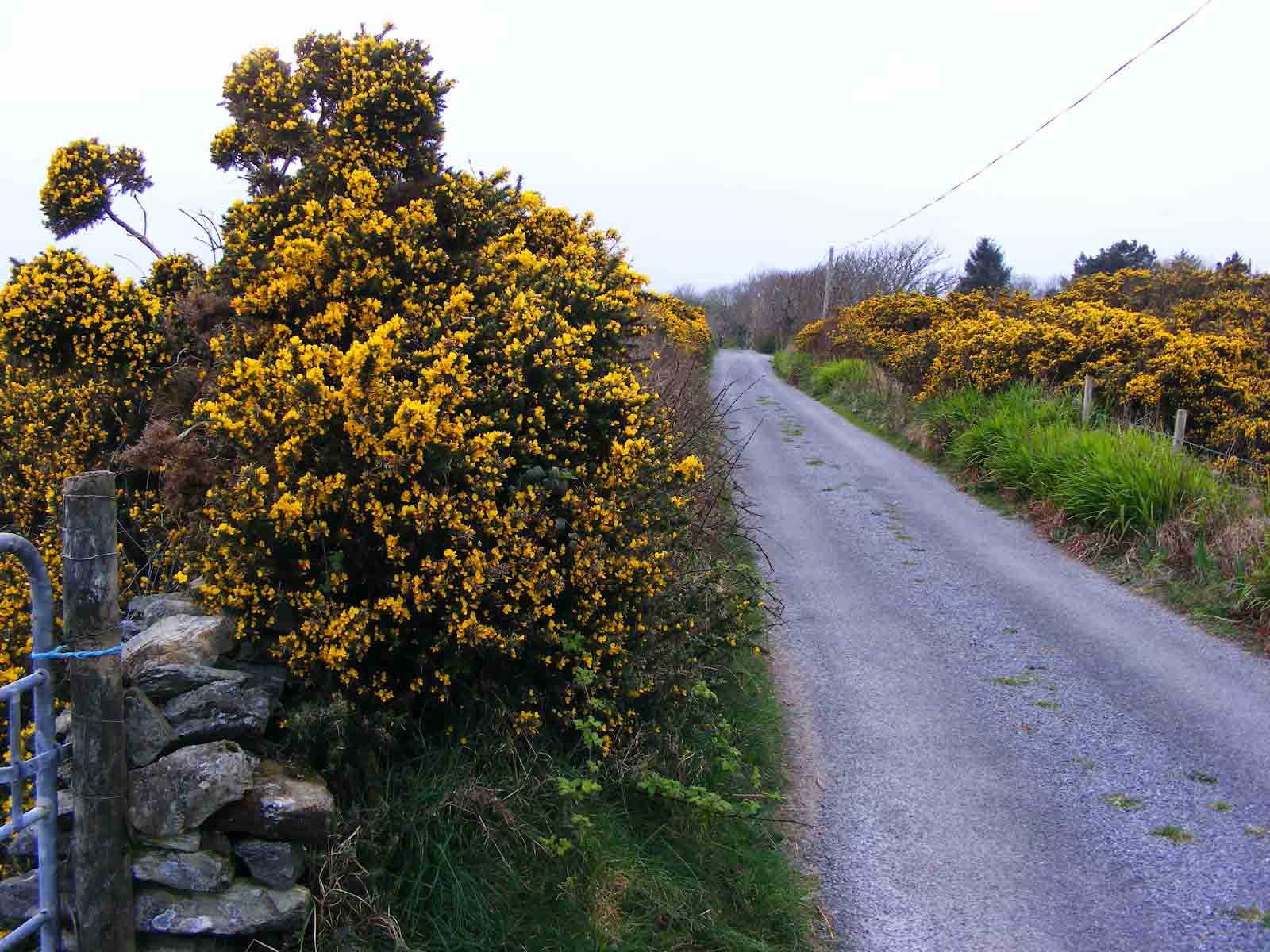
The wild Gorse is one of the most commonly found plants here in Connemara. We are fortunate enough to have a wall of it in our own back garden. The first few blossoms usually appear in February but they arrived soon after Christmas this year, presumably due to the mild weather. These yellow flowers are always a welcome sight after a long colourless Winter. At the moment the gorse is in full bloom everywhere and it is a sight to behold.
Here is a photo I took of a gorse lined road in Ardbear, just outside Clifden.


Gorse in Flower 1


The gorse stems are thorny and evergreen but the flowers smell like coconut, sweet and summery.
Here’s another picture, a little closer up.


Gorse in Flower 2


And just a mention for the Hawthorn – I stopped the car on the way back in to town to photograph this lovely old tree. I love its knarly branches and moss covered trunk.


Photo of a Hawthorn tree

White horses passing by

I took these photographs on my phone last week on Mannin beach which is just south of Clifden. It was the last day of school so my three daughters and I headed for the beach in the afternoon with a picnic. Mannin hosts a hard to rival string of beaches along its coastline near the village of Ballyconneely. We spotted these white horses in the distance when we reached the shore.


White Horses 1


They had spotted us too and lost no time in moving towards us.


White Horses 2


Such a beautiful sight, almost surreal against the backdop of sand and sky.


White Horses 3

Sketches in paint 2

These sketches are all based on the same scene, along the coast just outside the village of Claddaghduff, which is about seven or eight miles from Clifden.
In the vein of loose painting, I completed them very quickly (if they can be called complete). One is on a colored paper and the other two are on a heavy acrylic paper.


Painting: Claddaghduff landscape 1


Painting: Claddaghduff landscape 2


Painting: Claddaghduff landscape 3


I enjoy working on a colored ground or paper and it is not quite the same thing as paper that I have colored myself, although I probably need to work on this. Psychologically, one feels more free straight away and I think this usually shows. It has something to do with the daunting hold a blank white sheet of paper has on the mind – it scares us a little. This really should not be the case for someone like myself who has been putting paint on paper since childhood but I do think that it is so.
The other point about these colored papers is that they are very light and not really designed for heavy applications of paint. They tend to buckle especially if larger in size than about A5. This does not bother me especially but may be off putting for a potential buyer/owner of the piece. What is your opinion?

Sketches in paint 1

This photograph of a grouping of trees is not far from Clifden castle, just outside the town. I took it from quite a distance so the image is a little unclear.


Photo of trees


The trees in Connemara are few and far between, mostly Hawthorn which are slow growing and can withstand the harsh weather. They have a tendency to grow in the direction of the prevailing wind as in the photo and appear quite striking. Here’s my sketch below –


Painting of trees


I chose to straighten the tree in this instance but I am making a mental note as I type to return to this subject again soon. It is done on a blank water colour paper, postcard size. I’ve used a little charcoal to highlight the shadows and I’ve allowed the paint to fall down the page where it was thin.