Gavin Lavelle Exhibition – Clifden Arts Week

Spiral Eye by Gavin Lavelle

Spiral Eye by Gavin Lavelle

Gavin Lavelle opened an exhibition of his work this week end for Clifden Arts Week. The display is located at the Station House on the Galway Road and it comprises of twelve new works. The large space is divided into three rooms, the accompanying rooms feature work by Irish landscape artist Joe Wilson and artist and woodturner Angie Williams. The diversity of material and colour make for an interesting exhibition that showcases the high standard of artwork being made here in Connemara. Continue reading

New – The Gallery Shop

The Gallery Shop Logo


The Lavelle Gallery is delighted to open The Gallery Shop. This is a brand new venture that slots seamlessly into the existing gallery space, offering our customers a new and interesting selection of design led stationery and gift items. So far we have had a hugely positive response from our visitors and from our local customers. 99% of the products retail under €20.00 and this is no accident because as well as providing another dimension to the gallery, we want these items to be affordable to all. Continue reading

September’s Bounty

Two weeks after my last post and still I find myself singing September’s praise.  At the same time, I feel guilty because I haven’t yet found the time to paint as I have been trying to corner all of the dull but essential work that has gathered like old dust over the summer. I find it impossible to be creative with the burden of unfinished chores hanging around, but the end is almost in sight. In spite of this, the month of september has been extraordinary in so many ways. It slunk in surreptitiously after August with a wave of unexpected warmth, some truly breathtaking sunsets and an enormous silvery harvest moon that doesn’t seem to want to leave. This and a small boon of growth in my very own back garden.


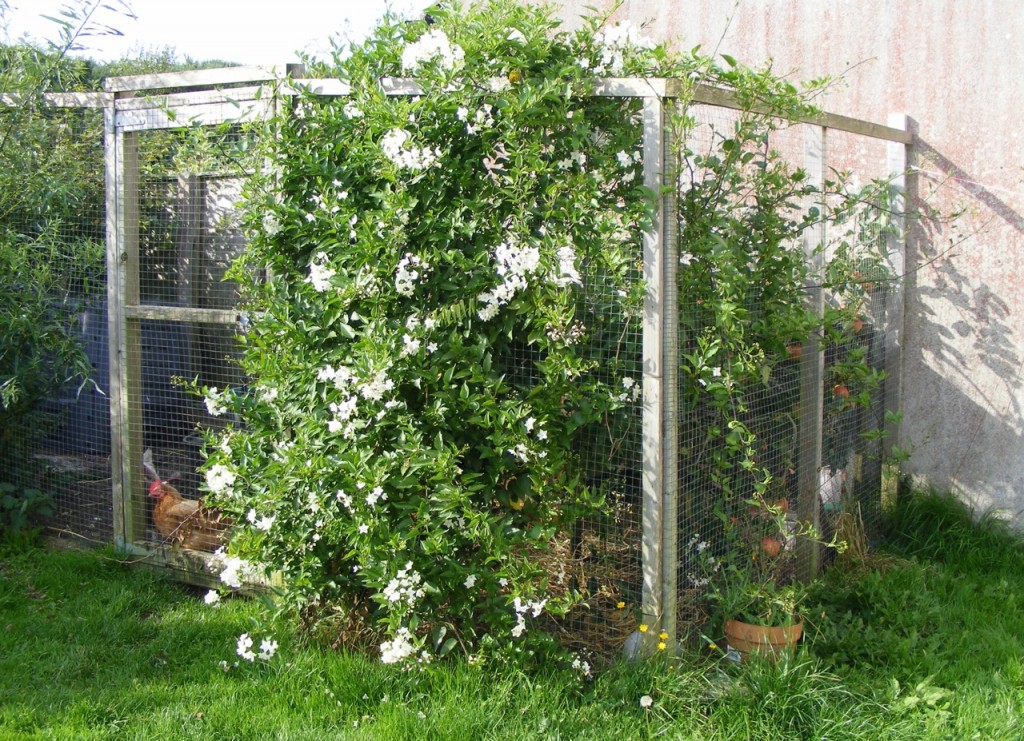
Hen coop surrounded by Jasmine

Our hen coop festooned with Winter Jasmine


My hen house is looking especially fetching and I fancy that the hens are wondering why so much of nature’s extravagance has been bestowed upon them. One side of the coop is covered in ‘Winter Jasmine’ and the other is laden down with ripening apples. The apple tree came to us in a small pot several years ago from my granny and the jasmine came from Lidl and began it’s life here as a sad little twig. My Dad revealed to me the source of all of this growth when I mentioned it – the hen shit, it’s the hen shit of course!


Hens in September

Our hens enjoying the weather and the jasmine


Here’s a few close ups.


Close up of ripening apples

Apples almost ready to pick


Winter Jasmine against the sky

Jasmine against a blue sky


Let’s hope the good weather and all it’s bounty lasts a little longer, the signs are good so far..

Gallery Makeover

Hugh O’Donnell at work – July 2014

We’ve had an exciting and busy few months at the Lavelle Art Gallery this Summer. Our lovely old building on Main Street Clifden has been getting a makeover and it’s well underway. Work began in July with the inimitable work ethic of Mr Hugh O’Donnell who repainted the whole building in glorious Indian Palace yellow in just over a day. The gallery has been painted this colour since the early 1980’s and it just wouldn’t be right to choose any other, in fact bright yellow is a part of our identity that we are proud to preserve. Continue reading

September Beginnings and Endings

Cover image ‘Sheep in Errislannan’ by Marianne Chayet

(This piece was written for the next issue of the Connemara Journal which will be available in early September. My three children have returned to school and I am looking forward to returning to painting and writing with renewed energy. I will post again soon.)


Summer is over – bright pink heathers have dulled and roadside montbretia looks a little battered after recent rain but there is a lushness still to the land and the evenings hold on to the light. It is not uncommon to view September as a time of endings; the end of summer, the end of the holidays, time to weed out plant pots or finish a garden project before the cold weather sets in.

I’ve always thought of September as a time of beginnings – the start of a new school year, time to investigate a new course of study perhaps or take up some exercise. The month of September seems to me to hold a promise of newness and renewal in a more definitive way than the beginning of the calendar year. I loved the smell of new books and pencils as a child and I looked forward to packing my bag for the return to school – I was especially thrilled if I had some new art supplies or if I’d been successful in obtaining a much coveted fluffy pencil case from the local newsagents!


Maam Cross Landscape with sheep by Alan Kenny

‘Maam Cross Landscape with Sheep’ by Alan Kenny


It is the landscape that reminds me that there are no beginnings or endings. I love to watch the land at this time of year in an effort to grasp those imperceptible changes, the quiet movement from heathery sweet colour into the deep golden hues of Autumn. It is almost impossible to capture the transformation as grasses and plants evolve so fluently and so exquisitely, yet we see them once they are changed. As humans we like to compartmentalise our lives into tidy segments and of course we need this in order to manage our activities but I find it oddly comforting to realise that there are no divisions, only the quiet reassuring passage of time. Ideally this can prompt us into action to make the most of each day but it can also allow us to realise the importance and significance of smaller moments as we salute another September and endeavour to make our own imprint on the world.


Kaleidoscope of Autumn by Diana Pivovarova

‘Kaleidoscope of Autumn’ by Diana Pivovarova 


Original paintings available at the Lavelle Art Gallery, Clifden ( www.lavelleartgallery.ie ) Our brand new website is under construction but will be going live very soon – stay tuned!

Jon Crocker – Soul Paintings

Cover image ‘Tommy of Connemara’ by Jon Crocker


Just a couple of notes on this piece – I wrote it for the August issue of the Connemara Journal which will be available soon. Also, we are working on a new website for our gallery which will go live in the next week or so – I will signpost this when it happens on this blog.


We are fortunate to meet artists from all around the world who find their way into our gallery (Lavelle Art Gallery) in Clifden for one reason or another. Each year we look at new creations, talk to artists and decide whether or not we can work together and whether the paintings or drawings will compliment the art that we already have. Occasionally the artwork is of such a high caliber that a decision scarcely needs to be made. This happened recently when Jon Crocker brought his water colours into us. Originally from Colorado, Jon relocated to Dublin after losing his wife and daughter to illness. He now divides his time between the United States and Ireland, which has become a second home.

Figurative work of a high standard is notoriously difficult to find and it must have a degree of technical sufficiency in order for it to work on any level. Jon’s portraits in water colour are not only technically brilliant and sensitively handled, they reach towards that intangible quality that makes each human being an individual. The likenesses that Jon creates are more than physical, he captures something else – an insight into identity that might be described as a spark or as Jon himself explains ‘the true essence’ or ‘soul’ of a person.

Jon has two paintings that stand out straight away – the first entitled ‘Tommy of Connemara’ and the second of a well known man from Dublin city called ‘Shamus.’


Shamus by Jon Crocker

Shamus’ by Jon Crocker


These portraits are both of well known characters, people that we have come to associate with a place, perhaps without even knowing that person by name. This led me to think about what it is that makes up the fabric of a town – it’s people yes but who are these people? Are they the leaders, organisers, business people? Are they simply inhabitants? Or is a place also defined by those who are just out of sight – the characters that we might see every day or once a week, perhaps on the same street or outside a certain building. We might have spoken or we might just have shared a nod or a smile. Tommy is one such character and we felt a small measure of how well this man is regarded when we posted an image of this portrait on our gallery facebook page. It was ‘liked’ instantly, warmly commented on multiple times and shared in a manner that we have not witnessed since we set up the page several years ago. This unprecedented reaction is also credit to Jon’s talent and we are more than delighted to be representing his work at the Lavelle Gallery. Jon produces prints of his original water colours at affordable prices as well as his one of a kind paintings, so people may enjoy his work with minimum investment.

It is worth noting that Jon is also a very fine landscape painter as exemplified by his painting of the old curragh at the shore ‘Molly Sea.’


Molly Sea by Jon Crocker

‘Molly Sea’ by Jon Crocker


You can read more about Jon and his work on his website at crockerfinearts.com or at the gallery website lavelleartgallery.ie or drop into the gallery to see them for yourself.

We join Jon in taking the opportunity to send Tommy Heffernan our good wishes as he is unwell at the moment.

Clare Island

(I wrote this piece for the current issue of the Connemara Journal. I have not had much time to post on this blog since the kids got their summer holidays and I apologise in advance, as I expect this will continue until they return at the end of August.)


An unexpected painting commission provided my family and I with a very good reason to visit Clare Island this month. I am ashamed to say that I had never been to the island in the twenty odd years I have lived in this area although I have been told about it’s charms on many occasions. Suffice to say that we were not disappointed.

A little research told us to get to Roonagh pier just outside Louisburgh, where we had a choice of times and ferry operators to make the short crossing. This was the first surprise as the crossing is indeed short – just fiveteen minutes – a bonus for a feeble land lubber such as myself. The second delight was the harbour which is quite idyllic in it’s picturesque sweep of sand and pier. The water was a clear turquoise blue, right up to the pier wall and we were able to admire some large fish and jellyfish over the side of the boat before we disembarked. I don’t think I have ever seen such clean waters in a harbour.


Clare Island harbour

The approach to Clare island harbour


I had made enquires about accommodation and there are several places to choose from. We chose O’Grady’s Guesthouse over looking the beach. We soon discovered that this was the old family homestead of the well known O’Grady family in Clifden, although the current building is completely new. A three minute walk brought us to the front door of Helen and Alan O’Grady’s beautiful stone clad home which conceals bright, spacious rooms worthy of any four star hotel. Helen greeted us warmly and told us about some of the ‘must see’ spots on the island. Our first port of call was the Sailors bar, not for refreshments ( we had those later ) but where we met with our very own Michael Gibbons who was conducting a archaeological tour of the island. This brought us along the coast, where we were entertained with stories of a lost Spanish ship that found itself on a stony shore and the slaughter and tyranny of a different time – quite difficult to imagine in such a tranquil setting. Michael then led us through an ancient wood, buried for thousands of years beneath the bog and now revealed as the knarled and blackened stumps of trees as old as time itself. We left the group about half way along to make a detour to ‘Anna’s Coffee shop’ in anticipation of her ‘famous chocolate cake’ which had been heartily recommended to us. We enjoyed a feast of home made salads and breads in Anna’s garden before retiring inside to enjoy a coffee and a generous slice of her truly delicious cake.

We continued the afternoon in holiday style with a swim at the harbour beach followed by fresh fish and chips at the Sailors bar.

The next day we made time to visit the Abbey, which is about a twenty minute walk from the harbour. This small rectangular building dates from the 12th century and has been beautifully restored and maintained.  Inside, it boasts the best example of rare medieval roof paintings in Ireland. The delicate array of small paintings cover the alter ceiling and depict a variety of mythical, human and animal figures including dragons, stags, birds and trees. There was a professional restorer working on them when we went inside and she pointed out a large relief carving of the O’Malley family crest and the final resting place of the infamous Grace O’Malley which is set into the wall.


SAMSUNG DIGITAL CAMERA

12th century Abbey at Clare Island


We left the island feeling revived and also very impressed with this small community of people who have so carefully and successfully managed their heritage, creating an oasis of tranquillity and hospitality that is hard to match.

Delphi Valley

It’s been too long since my last post as I’ve been caught up in the busyness of life and children. I’m returning with a short post  about a couple of new paintings I’ve just started. These are based on the Delphi valley, which must be one of  the most spectacular views here on the edges of Connemara and County Mayo. I’m working on a couple of canvases at the same time, alternating between the two. This one ( above ) is 10″ x 9.5″  – I’ve kept the palette quite cool so far with lots of blue and green. The second piece below is 10.5″ x 7.5″ and I’ve warmed this one up with some pink.


Delphi Valley with pink road, first stage.


I love this shade of pink – I think it’s everywhere at this time of year, not like this of course but you can see it in a haze over the grasses if you squint your eyes.

I’ll take more photos as these paintings progress and post about them again soon.

June Bog Cotton

Cover photo ‘Cotton and Turf in Connemara’ by Deborah Watkins


The landscape seems to transform itself every couple of weeks in Connemara. Perhaps the most striking feature at the moment is the bog cotton that has sprung up amidst the peat and laid out stacks of turf. This plant seems especially strong this year, perhaps due to the mild weather and also the ash enriched soil following the gorse fires last April. After the fires, these same fields were reduced to a black shadow of charred roots and dirt. I find it remarkable that the same earth can not only renew itself in the space of a year but reinvigorate into an oasis of life and colour.

Bog cotton is a species of sedge which begins to flower in April or May. Fertilisation follows in early summer when it’s small brown and green flowers develop hairy white seed heads that resemble cotton. It can be difficult for the observer to discern from the roadside and the effect is rather like a field of large daisies but on closer inspection, the fluffy cotton heads are unmistakable. Unlike Gossypium cotton from which fabric is derived, this species is unsuited to textile manufacturing. However the plant does have a history of various uses as a cotton substitute – in the production of paper and candlewicks in Germany and as wound dressings in Scotland during World War I.


Bog Cotton close up by Deborah Watkins

Many headed bog cotton by Deborah Watkins


Bog cotton comes in two forms in Ireland – single headed and many headed bog cotton. The two plants are similar in appearance but flourish differently. The many headed bog cotton grows in pools of water – air canals in it’s roots allow air to pass from the surface to the roots in a kind of ‘snorkling’ process. The leaves of this plant are wide with red tips. The single headed bog cotton does not have these air canals. It grows on the drier surface of the bog and it’s leaves are long and needle like to conserve water.


Single headed Bog Cotton

Single headed Bog Cotton by Deborah Watkins


Bog Cotton by Deborah Watkins

Cotton fields of Connemara by Deborah Watkins 


Like many of our indigenous plants in Connemara, the bog cotton is special to this place and this particular time of year. It is also a reminder of the regenerating nature of the earth in even the harshest of conditions.


Gorse – The Colour of Summer

I wrote this piece for the May issue of the Connemara Journal, which will be available shortly.

April brought unexpected heat as well as more predictable showers this year –  a boon of warmth and rain that has resulted in a rush of growth all over Connemara. My own back garden seemed to come alive with colour overnight – new leaves and blossoms swelled in perfect haste, you could almost hear the growth. The gorse transformed itself invisibly from a few scattered flowers into a sea of deep egg yellow that steals a little further every day. Also known as furze, the scent of this impressive plant is subtle but heady, something like the delicate sweetness of coconut. Along with our native fuchsia, it is the shrub that most people associate with this part of the world and it’s hardiness and vivid beauty describe this place like no other. It is also one of our longest flowering plants, coming into it’s own in April (although blooms can be seen much earlier) and lasting right though the summer and into early winter.


Roadside 1

Late summer gorse and heathers at the roadside in Errislannin by Deborah Watkins


It is hard not to miss the gorse in Connemara at the moment, in thick banks along the roadsides and in great mounds and ridges that brighten the landscape. It is closely related to the brooms species of plant and they share similar characteristics with their dense slender stems and very small leaves. Gorse distinguishes itself with it’s sharp thorns ( which can measure up to four centimetres long ) and it’s bright showy flowers are always yellow.


Another photo of gorse

Gorse thorns and blossoms by Deborah Watkins


Gorse has a long history as a fuel because it is easy to burn and it burns very well, reputedly giving off as much heat as charcoal. The ashes it produces are rich in alkali which are very enriching for the soil so it is often burnt down to improve the quality of the land, a practice which is hazardous in dry weather.

Historically, the bark and flowers have been used to produce a yellow dye and gorse flowers have also been used to add flavour and colour to whiskey. In homeopathy the gorse is used as a remedy to give people courage. It’s evergreen leaves and long flowering blossoms are a reminder of the returning sun after short winter days, it’s cheery colour a promise of summer.