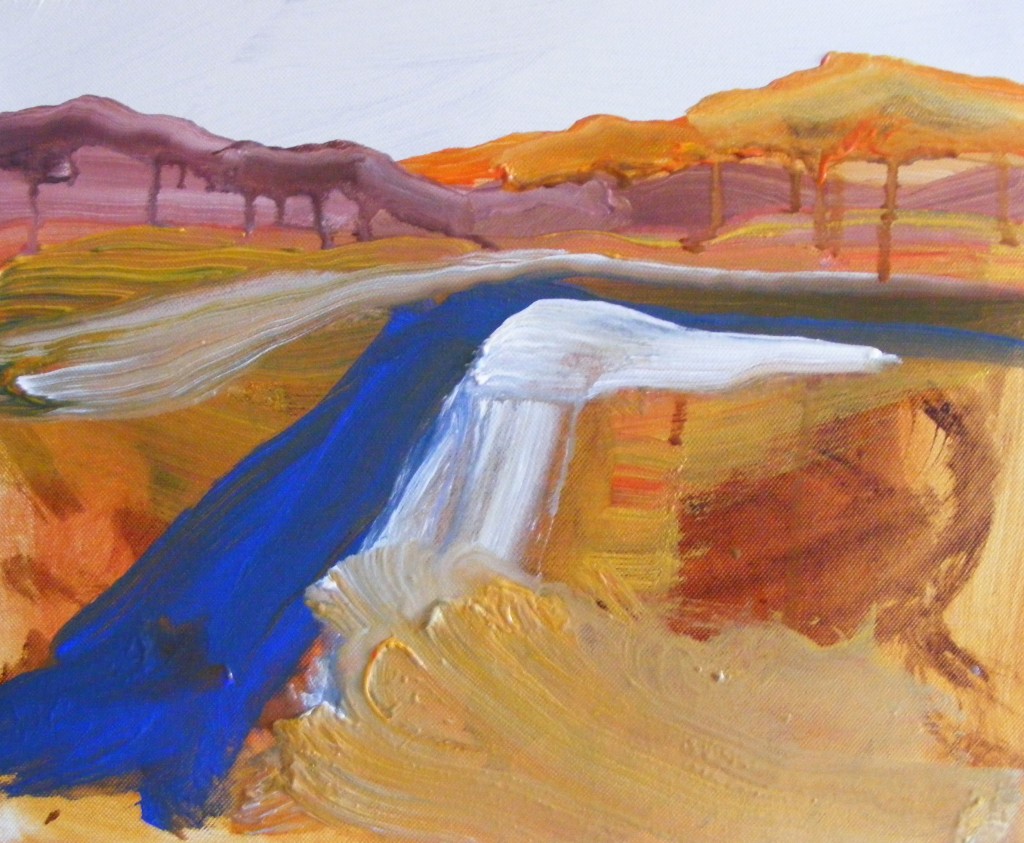
Winter’s end landscape

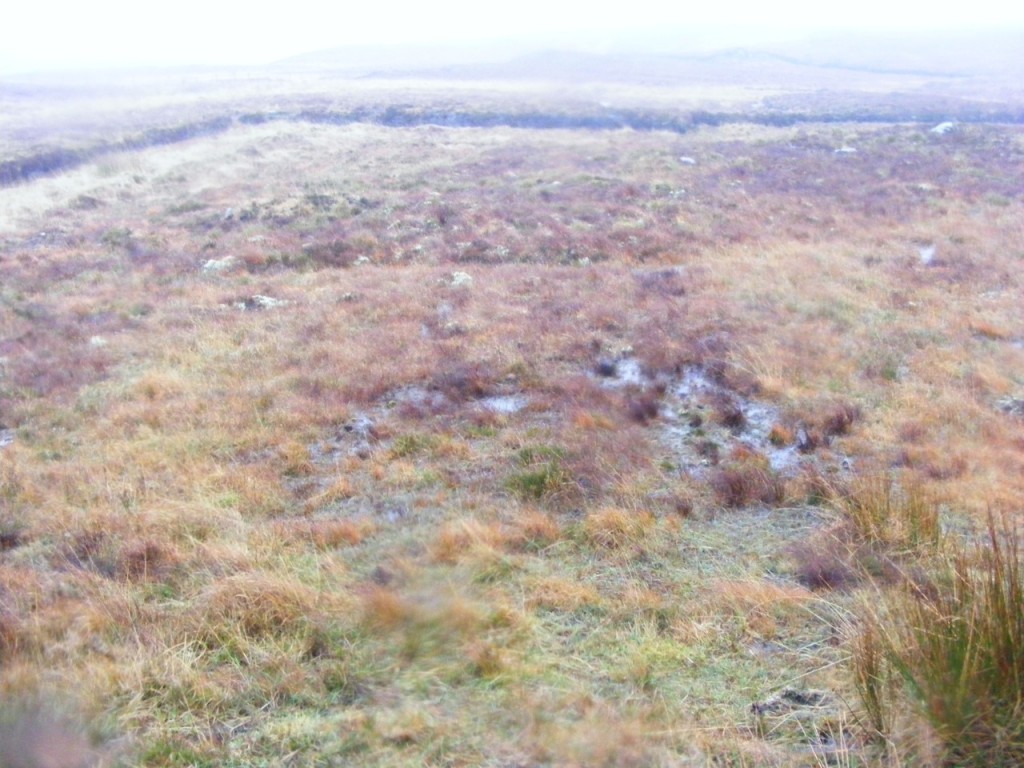
I’ve just finished this painting. The canvas is 12″ x 16″ and it’s based on some photos I took last month. The landscape had a bleached look to it that is only starting to change now. It’s unusual not to see more Spring colour here at this time of year but we’ve had a very long spell of unseasonably cold and dry weather which has delayed the new growth.

Here’s how this painting began. I’ve roughed in the composition and I’ve added some textured paste to the foreground.


First stage of Winter's end landscape


Next some more colour. I decide to leave the background more or less as it is.


Second stage of Winter's end landscape


Next I concentrate on this gorge in the foreground. This represents an area of cut bog and I want it to contrast with the lightness of the grasses so I go in with lots of darks – sepias and earthy reds.


Third stage of Winter's end landscape


Here’s a couple of close ups below.


Close up 1


Winter's end close up 2


At this point I decided to add a little green to the piece. I chose a pearlescent silvery green below.


Winter's end landscape almost finished


Now a bit of tidying up and just a little more green, this time it’s a sap green.
 

Finished landscape by Deborah Watkins

Charred Ground

I took these photographs recently which show the aftermath of the gorse fires here in Connemara. They show the extent of the damage – massive areas of land have been blackened by the fires right up to the roadside.


The charred roadsides near Moyard


I sometimes wonder about the benefits v disadvantages of my near total ignorance of the technical business of photography. These pictures were taken on my trusted Fugifilm camera which I’ve had for about five years. I realised that it was on a ‘sunset’ setting after I had taken most of my photos. I subsequently changed to the ‘auto’ button which is supposed to find the optimum setting for the prevailing conditions. However, the last pictures I took ( of which this is not the worst example below ) were a horrible blue colour and poorly reflected the actual light conditions at the time. The former photos have a lovely sepia tinge to them which accentuated the actual light, giving them an old, other worldly feel.


Photo of charred landscape with bluish tinge


I suppose that I quite enjoy the accidental nature of these small discoveries while I have to admit that more knowledge on the technical front would not be a bad thing. The prospect of acquiring this information has just never seemed very appealing to me and I am indebted to my camera which (for the most part ) does the job for me..

Here’s some more photos – I like the desert like feel to this one below.


Charred ground after the gorse fires


This last one might just have been good old Kansas before Dorothy was wooshed up into the sky..

It is in fact the last stretch of open bog on the road to Moyard/Letterfrack.


Fields of ash, near Moyard after the fires

Burning

Fires have been burning here in Connemara for the past week. I stopped en route to Dublin to take these pictures at the weekend. This particular stretch of bog became a creeping line of fire that landowners struggled to contain.


Burning bog near Oughterard


It’s an annual sight here and the only way to control the voracious growth of the gorse plant. The ash from the fires also gives much needed nutrients back to the earth which promotes new growth, a kind of seasonal cleansing and renewal. The problem arises when fires get out of control and with the fact that it is illegal to burn growing vegetation in this area between March 1st and August 31st. Unfortunately this period is often the only suitable time for burning to take place due to the length and inclement nature of Winter in Connemara.


Gorse burning in the distance - Near  Oughterard


We have had an unseasonal amount of rain since October last followed by an unusually long spell of dry windy weather. This has led to the rash of out of control fires in Connemara this month. The garda helicopter was called in to assist fire services in tackling a number of blazes near Spiddal and Moycullen. The wind direction hampered their efforts and has caused the rapid spread of fires which may otherwise have remained under control.

A stretch of road was closed in this area at the week end while I was away. I could see why when I returned last night and stopped to photograph the ashen land which now reached the edges of the road. My camera struggled to capture the colours as the light was fading but these photos give an impression of the charred landscape below.


Charred landscape near Oughterard


Charred landscape II


Theres something eerily beautiful about this blackened place and I will return soon to take more pictures during the day. Thanks to the efforts of the Clifden fire service, there was no loss of life or serious damage to property and hopefully this position will continue.


ADDENDUM

I understand that it is widely believed that some of these recent fires have been ignited unlawfully and not by landowners and that the gardai are involved. It is remiss of me to have suggested that any landowners were involved in this latest series of gorse fires. I met with friends this evening who spoke of the extent of the fires in the Moyard and Cleggan area and how the blaze came dangerously close to several homes, causing significant damage to some property and to underground pipes. It is also quite feasible that some of the fires may have been caused by accident or heedlessness due to the particularly dry nature of the bog grasses at the moment.


Easter Holiday

Cover Image taken from Eahkee Original Outsider Art at etsy.com


I’m taking a break for Easter. This is unplanned and due to the length of the school holidays ( two whole weeks! ) and the hectic nature of my days since the kids finished up.

Have a happy Easter – I’ll be back in April 🙂

Ghosts of the Faithful Departed

Have a look at this video by photographer David Creedon. Such gorgeous imagery from another time. Many things strike me about it – so much was left behind, the colours of the walls are striking compared with pale modern decoration and there is religious imagery everywhere. It is sad and indeed ghostly because of the subject matter and the print of human life that remains. These rooms have been photographed beautifully and reverently as they appear to crumple and disintegrate before our eyes.


March Landscape

This landscape is probably more true to how the landscape actually looks at the moment than others I’ve done recently. Along with the richness of some of the colours, theres a bleached out feeling to the old growth which has been touched on in this piece. It started out like this below.


March Landscape - first stage


Next I added some textured paste to define this long gully that disappears into the distance and the movement of the grasses on either side of it.


March Landscape - Second stage


Here’s a close up of some of the marks below.


Second stage - close up


Next, I’ve loaded the canvas with colour. I’ve left the mountains in the background as they were – just a simple wash of colours as I want them to recede behind the ‘action’ in the foreground.


March Landscape - Third Landscape


Another close up below. I’ve applied the paint thickly and in layers, sometimes wet on wet.


Third stage - close up


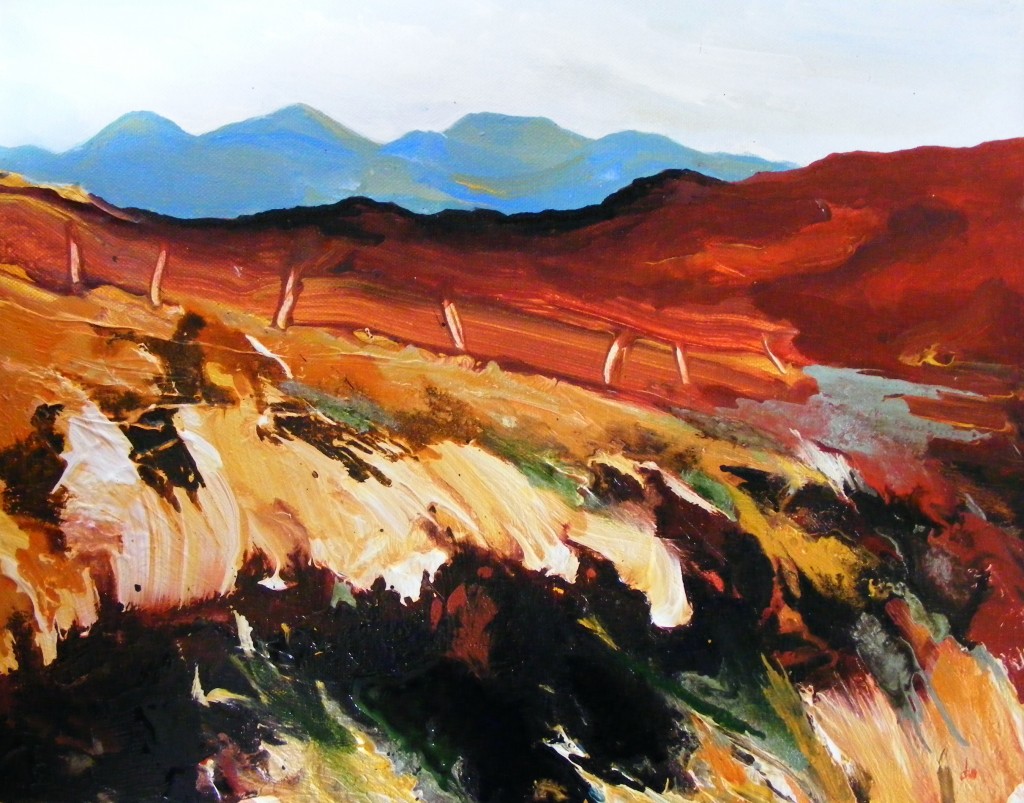
Here’s the finished piece. I’ve left this small area of white at the point where the gully fades into the background. The eye is drawn to that point so it seems right that it should be the brightest patch. I’m happy with this one – the swirling energy of the grasses and the landscape against the cool austerity of the hills in the distance. I like the brighter tones in this piece too which I’m going to try to keep for the next few paintings. What do you think?


Finished March Landscape

Surge


I began this painting (above) a week or more ago. It is loosely based on some photographs I took in the bog this year, particularly this fuzzy looking one with the trenches at right angles in the distance.


Rainy landscape photo by Deborah Watkins


I started work on a 12″ x 14″ x 1.5″ canvas and outlined the composition with broad strokes of colour. I’ve accentuated the right angled trench and made it the centre of attention.


First stage of 'Surge' painting


Next I added some textured paste. I’m really enjoying this stuff – it does exactly what you want it to do, so when you put it on the canvas it doesn’t slide off and it holds it’s shape perfectly until it dries.


Second stage of 'Surge' painting


Here are some close ups – I’ve used my hands to make the marks, as well as brushes of different sizes and various tools that came to hand. I’m interested in putting some energy into the piece with these marks, in making the surface seem to writhe with movement as it sometimes appears to do in life.


Close up of textured paste


Second close up


The paste takes several hours to dry completely so I return to it the next day. I go back in with colour to describe the grasses and the landscape and I make the trench a watery one with blues.


Next stage of painting


This is what the piece looks like when it’s still wet and after lots of colour has been applied (below).


More colour added to painting


The paint loses it’s gloss once it has dried (below) but this will return later once the canvas has been varnished.


February Landscape


When I look at it again, I realise that there are too many horizontal lines and shapes which need to be broken up. I decide to correct this by making some small vertical shapes in the centre of the canvas so that the eye is carried around the painting rather than stopping at the point where this trench shape ends.


Finished Landscape


I’m pleased with the results and I’ve decided to call the piece ‘Surge’. This describes for me the movement of the landscape – movement that the eye can see but also the shiftings that take place over hundreds of years. Thousands of years. Layers of matter building up all the time and layers being washed away. I love this notion of the land as a living thing, observed cooly in the distance by the unchanging character of the mountains.

Sundown

I went out to the Bog Road between Clifden and Moyard last week. It was about 5.30pm and the light was really beautiful, low and clear. The colour of the bog grasses was striking – rich metallic shades of gold, copper and bronze. There was still some warmth left in the sun but the wind had a bite to it which isn’t evident in these pictures – the colours are so deceptively warm, it could be some hot and arid place..


Photograph of bog by Deborah Watkins


I wandered down this road to get a better look – a typical Irish side road with impressive pot holes..


Road with pot holes


Mmmm, need a tractor to get through this next bit, good job I brought my wellies..but just look at the blues reflected in this pool.


Photograph of flooded road by Deborah Watkins


One last picture, I like the way the hill peaks over the top of the road in this one.


Road through bog by Deborah Watkins


The Dash

Spring might just be on it’s way after all. We’ve had a whole week of dry weather which is very welcome indeed after all the rain we’ve been having since Christmas. Although it is very cold ( oh yes that wind can slice the skin ) it is a tonic to have clear blue skies overhead and to feel the sun again. My garden is slowly beginning to recover and harden from the sludgy waste ground it had become. There are spots of colour too reaching out in the few daffodils forgotten since last year and the bursts of new growth by the roadside. Every bit of this is long awaited, long earned.

I came across a poem which expresses this beautifully. It is called ‘The Dash’ and it is written by Kathleen Jamie whose book ‘The Overhaul‘ was shortlisted for this years Costa Book awards. Kathleen is from the West of Scotland and her work has been honoured with many awards throughout her career. ‘The Overhaul’ is a collection of poems which seem to breathe the landscape where Kathleen is from. There is an engaging use of Scots speech in her poetry, much of which has similarities to gaelic and this gives the writing warmth and musicality. There are many similarities between Scotland and Connemara – the wildness and the ferocity of nature’s relationship with the land and the gentleness of it too – the beauty of the everyday and all it’s treasures.


The Dash


Every mid-February

those first days arrive

when the sun rises

higher than the Black

Hill at last. Brightness

and a crazy breeze

course from the same airt –

turned clods gleam, the trees’

topmost branches bend

shivering downwind.

They chase, this lithe pair

out of the far south

west, and though scalding

to our wintered eyes

look; we cry, it’s here


Kathleen Jamie


Image of Hawthorn by the roadside by Deborah Watkins

It’s a Hens Life

This post was inspired by fellow blogger, musician and writer Robin McArthur who recently invited me to send some pictures of my hen house for her blog. Well that just got me thinking about my own hens and how much I value them.

We decided to get some hens three years ago this Summer. It was something I’d hankered after for a while, inspired in part by stories about my Great Aunt Rita and her brood of hens in inner city Dublin a generation ago. She would invite her nieces and nephews to put cocoa in the hen food on Easter Saturday which miraculously turned into chocolate eggs for Easter Sunday, a treasured memory of my mothers. These hens would have been more than a fancy, they would have provided food for the table – breakfasts and suppers and supplies for baking. This lady made a wonderful Buttermilk cake with egg which my mother and I make regularly today – I think of Rita when I make it myself.


Bottoms up!

Bottoms up girls!


There is something important about these simple values – good husbandry and good housekeeping that we are beginning to return to. The pleasure that these productive creatures bring is hard to quantify.

Getting started does involve some work however and some investment. You will need a secure coop with nesting boxes and a safe run for your hens to exercise. Our hen house was a gift from my Dad. It’s a very handsome one and suitable for up to six hens.


Winter coop

Our coop with three hens – ‘Pip,’ ‘Cocoa’ and ‘Muffin’


We started off with two Rhode Island Reds which we were told are the best layers. We reckoned two hens would provide ample eggs for our family’s needs. I had been advised that having too many hens and therefore a lot of eggs is a consideration since you then have to then decide what to do with the surplus. If you have lots of family and friends who would welcome the eggs on a regular basis then this might not be an issue but the eggs still have to be collected and delivered. Once your coop and run are secure, the main threat to your hens is human error. I learnt this the hard way when I left the coop open for the first time in almost two years and the fox took both hens overnight. I’d been in Galway for the day and came home late, forgot to assign the job to another family member and forgot to check myself. I thought that this was just very bad luck but an expert later told me that the fox most likely goes round all the gardens every night. One error is all it takes for a happy fox and a very unhappy hen owner.

After a suitable mourning period ( we have three young daughters ) we decided to get three hens, one for each girl, which they chose themselves. This new brood consists of two Rhode Island Reds and one Bluebell. The Bluebell doesn’t lay as frequently as the Reds who produce one egg each every day but I believe that her laying life will be longer so she will be productive for more than two years. It’s an impressive production and something I feel grateful for on a daily basis – such hardworking girls! If your hens are happy, well fed and have as much roaming around room as possible, they will lay well. They need a bit of extra care over the Winter ( as do we all ) and so you need to make sure they are reasonably warm in low temperatures. I line the coop with cardboard and put a thermal picnic blanket and an old carpet over the top of the house for insulation.

I am the chief hen caretaker in our family and taking care of them is now a part of my daily routine. It takes me less than ten minutes in the morning to let them out, clean out the coop and put out enough food and water for the day. I usually check up on them during the day and I lock them up in the evening  – they can’t see in the dark so they usually make their way in themselves at dusk. I simply could not recommend this way of life enough and apart from the trauma of losing them to the fox ( may you learn by my mistakes! ) I cannot think of a single reason not to have hens. Did I mention that they make excellent models for painting?


second hen - third stage


Hen painting in progress


I leave you with my Aunt Rita’s recipe which is especially nice on the day it is baked with butter and hot tea.


Rita’s Buttermilk Cake

2 Breakfast cups Flour

2 oz margarine

1 tsp baking powder

1/2 tsp bread soda

1/2 tsp salt

3/4 cup sugar

fruit ( a generous handfull of raisins )

1 egg

8 fl oz Buttermilk or sour milk


Sieve flour into a bowl. Add baking powder, bread soda and salt. Rub in margarine. Then add sugar and fruit. In a separate bowl, beat the egg with the buttermilk. Add this mixture to the dry ingredients with enough milk to make a stiff batter. Pour into a greased tin ( I prefer a large loaf tin – my Mum likes to use an 8″ cake tin ) and leave for 15 mins before putting into a moderate oven ( 170 degrees ) for 45 mins. You’ll know it’s cooked when it becomes a warm golden brown colour and the base should sound hollow when you turn it out.