Here’s the clip from RTE’s ‘Nationwide’ programme that aired last month. It features my work and my studio and also the Lavelle Art Gallery here in Clifden where myself and my husband Gavin make our living.
Here’s the clip from RTE’s ‘Nationwide’ programme that aired last month. It features my work and my studio and also the Lavelle Art Gallery here in Clifden where myself and my husband Gavin make our living.
Here’s a couple of hen paintings I’ve been working on. They are at various stages of completion. The one above is the one I’m most happy with but it’s not quite finished yet. Here’s how it began below.

Here it is after a bit of work.
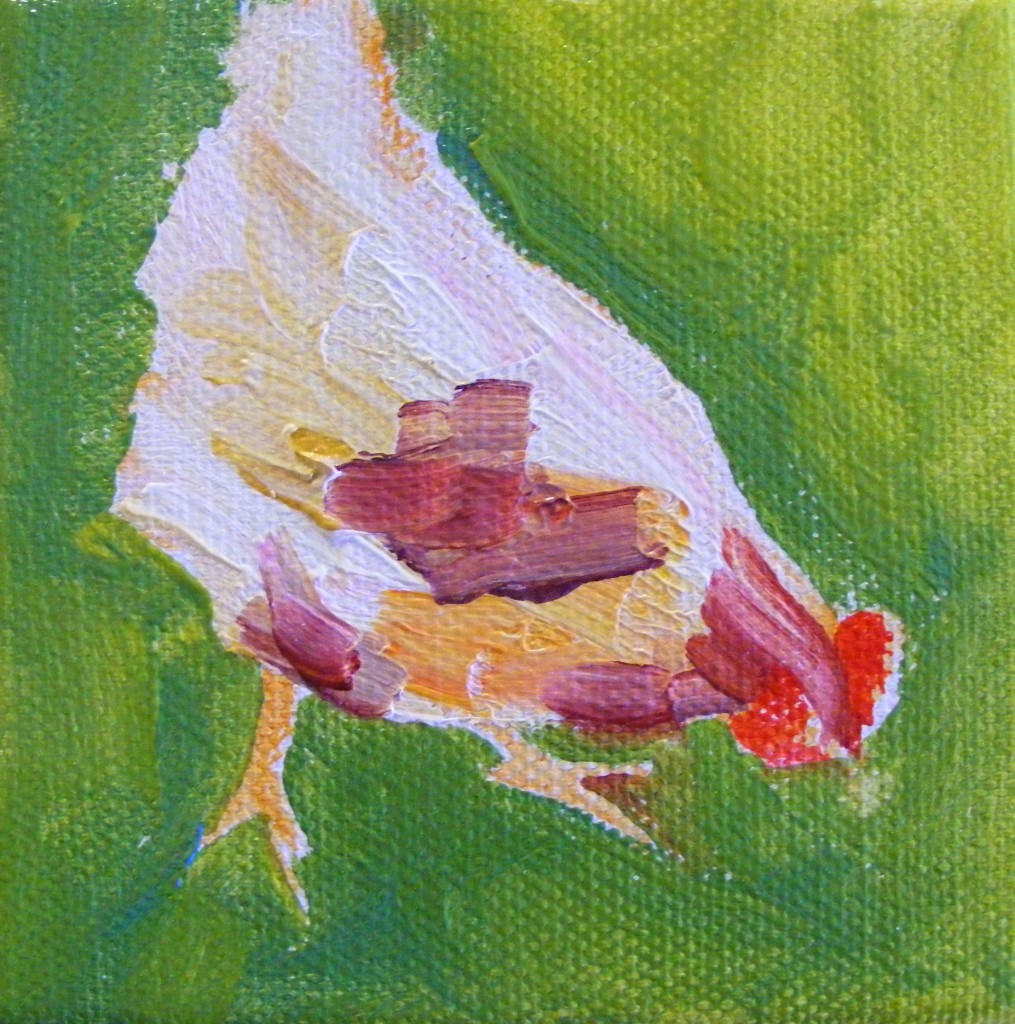
and after a little more work.

Just a small bit of detail needed, not too much or it will become fussy. Here’s two more paintings as they progressed.


I’ve overdone this one a bit and it is fussy – I still find it hard to get that balance right, between a lightness of touch – enough to express the movement and energy of these creatures with enough detail to justify calling it a painting ( not just a sketch ) but not so much that they become fussy and drained of energy and life. Still learning.
Maybe time for just one more post before Christmas, I have something seasonal in mind and then a couple of weeks of rest, glorious rest – school holidays and lies ins and rest. Lovely.
Still painting yes, but still using a roller and a very large bucket of matt white emulsion. I’d love to be one of those people who can manage more than one major project ( ie: painting the house and some other stuff as well – like the other kind of painting ) but sadly I am not and frankly it’s a wonder that the family haven’t starved and/or run out of clothes as this task has been truly all consuming. On the positive side though, the house has never looked better. Unseen corners that haven’t been noticed for years are emerging and EVERYTHING looks brighter – there’s a lot to be said for ‘Brilliant white’! I have had the occasional splurge of colour like this green wall (below) in my kitchen which I love. We have prints and paintings here that we have bought/collected and swapped over the past fiveteen fifteen years or so. The toaster sketch is by our friend Joyce Tansey and the Coffee Pot is by Blaise Smith. The print under the Toaster is by Kathe Kollwitz and the landscapes are by good friend and talented painter Mary Donnelly. The Little Trees drawing is by canadian artist Luke Ramsey. I love them all.

and just look at those shiny white skirting boards and that sparkly architrave – I do feel proud!
Here’s a bit of red in the front room below.

I love red and also have some in my kitchen. The fabric in the blind came from Ikea – out of date now. I still treasure it even though it’s a bit faded. There’s ‘Jellybean’ our ginger cat outside on the window sill..

I’m almost there, just another coat of gloss in the hall and that’s the downstairs done. Upstairs can wait till after Christmas..
Soon back to painting on canvas then – I’ve a couple of hen paintings that need to be finished which I’ll post about in a little while.
I drove to Galway city on Wednesday morning, a hundred mile round trip from Clifden town. It’s a journey I make about once a month and usually out of necessity when I have a sufficient amount of errands to run. This particular morning was beautiful – crisp and sunny and still. Fortunately I had my camera with me so I was able to pull in at Ballinafad and take some pictures. You might think that I’ve photoshopped these but it’s the real thing and exactly as it was ( I’m not a great fan of photoshop, especially when it comes to landscape ). This is the N59 looking towards Galway with ‘Lissoughter’ and ‘Binn Ramhar’ mountains on the left.

Here’s the road looking back towards Clifden with the lower slopes of Benn Lettery on the right and Ballinahinch Lake to the left.

And here’s the view south west taking in the lake and forest beyond.

Facing south now and some gorgeous reflections in the lake which was as clear and still as glass – the posts supporting the new saplings, the tree line of the forest and the fisherman’s beats outside this little shed. I love the grasses too, golden like burnt caramel and warm to the eye.

I find myself marveling at it all and the fact that I live in such a beautiful part of the country. I think back to the first time I took this road about twenty years ago and the thoughts that ran through my head. It was like going deeper and deeper in to the unknown, into a kind of wilderness. The water almost touches the road in places as it twists and turns around the lakes ( much narrower then ) and I remember finding this a bit unnerving. The remoteness of the landscape, which seemed to recede in to itself further and further was more than a little daunting for a city girl like me but the extraordinary beauty of the place was unmistakable. You might imagine that you would get used to it, stop seeing it perhaps and begin to take it all for granted but this simply isn’t true. Every season brings a change and each season has it’s own special kind of beauty and moments like these in Ballinafad are made for savouring.

The last time I worked on this painting, it looked like this (below)

It sat around for a long while and every so often, I would pick it up and tinker with it, always feeling that it needed something more. Here are some of the stages I brought it through;


During this time, the seasons changed and those bright yellows turned into darker browns. I thought I’d try to reflect this in the piece and to darken the whole painting considerably. Here’s the result below.

It’s a far cry from where it started! It has completely lost the freshness it had early on. There was something there at the first stage that really worked – the deep blue and ochre colours against each other especially. Perhaps I should have left it as it was but it did seem to me to have an unfinished air about it. I was very unsatisfied with all these in between stages but I am quite happy with it now in it’s darker form. It does seem to me to reflect the darker hues of the landscape at the moment. What do you think?

This is another painting in the Black Bog series that I’ve been working on. It’s similar to the last one featured here but it’s twice the size at 10 x 8 inches. This is how it began;

Next, I added a line of brown ink and dragged the colour downwards with a broad brush to give the lower part of the painting an under colour. I also used some gold paint.

Here’s the next stage below. I’ve used lots of colour – browns, reds, yellows and golds. I’ve manipulated the way the inks react with the paint to create interesting textures and I’ve worked with a variety of brushes to make different kinds of marks.

Once this layer of paint had dried completely, I worked on the piece again (below). I deepened the blues of the hills in the background and I darkened some of the colours to give the painting more contrast.

This is the finished piece below. Once again, I added more paint and ink when the last layer was completely dry. I altered the line of the bog slightly to make it less horizontal and I’ve given the bog more depth with these additional layers of colour.

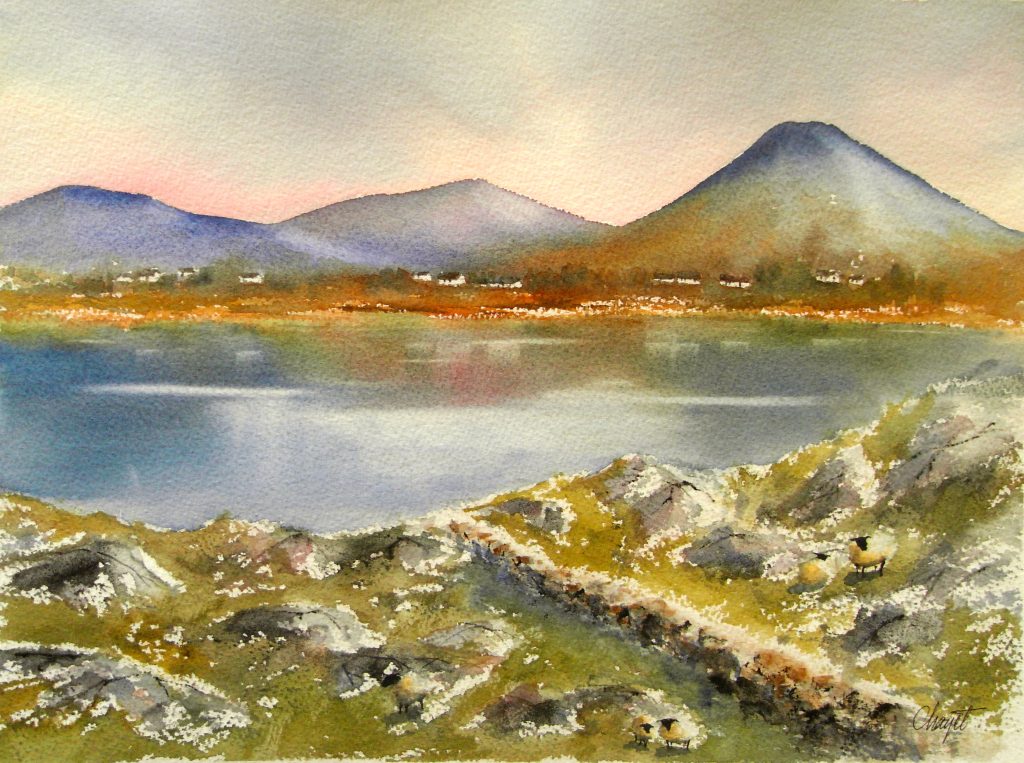
The first week of November has come and gone with more dry days than wet. It’s a remarkable thing here in Connemara where the rain is never far away. We feel grateful when we get a whole day of dry weather, even more grateful when we get two in a row. I find an excuse to go outdoors when it’s like this, everything else can wait; housekeeping, book keeping, laundry, shopping, even painting is put on hold. If I’m really organised I’ll put some washing out to dry first thing, so that I can leave guilt free.
I took these photos out on the bog road between Clifden and Roundstone. October’s gold has deepened to these Wintry hues, it’s brown all over and under – russety, chocolatey, chestnut brown. The light is low, shining across rather than above and making the brighter grasses glint like shards of coloured glass or metal.

The water makes a silvery stripe against the bog and there’s an inky blackness at the edges where the grasses are reflected. It makes me think of a pool of mercury sliding through the landscape.

There’s a stark kind of drama about it all, a bareness from the flat grey light of the sky that seems to muffle colour like sound. I like to track down the words, sometimes a verse to match the way the land looks. That’s how I stumbled across these lines from the poem ‘November‘ by John Payne. I think they fit the mood well – the setting is an empty stage and there’s more than a hint of darkness in the shadowy figure of Winter, laying in wait.
The tale of wake is told; the stage is bare,
The curtain falls upon the ended play;
November’s fogs arise, to hide away
The withered wrack of that which was so fair.
Summer is gone to be with things that were.
The sun is fallen from his ancient sway;
The night primaeval trenches on the day:
Without, the Winter waits upon the stair.
taken from ‘November‘ by John Payne ( 1842 – 1916 )
November is a difficult month. It’s the shock of losing the hour and the suddenness of it – it always feels more like losing two when overnight it’s dark at 6.00pm instead of 8.00pm. A sixth of the day gone, just like that, slipped out of the day and vanished into the blackness. I think the body reels from it for a while, misses the light without knowing what is the matter or what it is missing. It seems like a starker thing here in Connemara where nature is magnified; bigger spaces, bigger winds, giant silhouettes of mountains and grey days of rain in blustery torrents or invisible misty sheets. It’s taken me a long time to learn an acceptance of this and I have spent too much time resenting the end of the year and fighting the gloom of the approaching Winter with a grumble and a moan.
This changed for me after a trip to Brigit’s Garden just outside Galway city where I began to see the Winter garden sculpture (below) for what it is. This image of the sleeping woman is such a beautiful one. She is so peaceful looking and such a quiet, gentle figure in the space that you want to tiptoe around her for fear her slumber might be disturbed. Unexpectedly, it was she who woke me up to the reality of Winter as a necessary time in the cycle of the seasons. Just as we humans must sleep at the end of the day, the earth needs to rest and recover, to shed it’s leaves and all it’s colour and to sleep, so that it can prepare for new growth ahead. The secret for me was to see this changing time as a human form.

Image taken from Stream
Robert Frost has personified the gloominess we might feel at this time of year in his poem ‘My November Guest’ (below).
My November Guest
My Sorrow, when she’s here with me,
Thinks these dark days of autumn rain
Are beautiful as days can be;
She loves the bare, the withered tree;
She walks the sodden pasture land.
Her pleasure will not let me stay.
She talks and I am fain to list;
She’s glad the birds are gone away,
She’s glad her simple worsted gray
Is silver now with clinging mist.
The desolate, deserted trees,
The faded earth, the heavy sky,
The beauties she so truly sees,
She thinks I have no eye for these,
And vexes me for reasons why.
Not yesterday I learned to know
The love of bare November days
Before the coming of the snow,
But it were vain to tell her so,
And they are better for her praise.
Robert Frost ( 1874 – 1963 )
The humanising of sorrow in this poem lessens it. It is no longer an overwhelming feeling but a human being, a woman who has simply stepped in, although she is uninvited. Frost acknowledges her presence and by doing so he accepts these feelings while he tells of the beauty of Winter, the ‘faded earth’ and the silver ‘clinging mist’. It’s a struggle because she ‘vexes him for reasons why’ but he is listening and seeing nature’s beauty for himself, he has learned to ‘know the love of bare November days.’
As I think perhaps I have too.
Cover image is ‘Harsh Life’ by Inez Streefkerk

This image of Roundstone bog inspired the painting above. It’s unremarkable as a photograph but I love the contrast in it, between the darkness of the boggy landscape and the gem like blues of the mountains and paleness of the sky.

This is how the painting started below.

I started at the top of the page and kept the colours clean when working on the sky and mountain shapes. Then I outlined the line of the land in a dark ink and I dragged some of the colour down using a brush to make a yellowish wash. This is the how the painting developed below.

I worked quickly using a combination of acrylic paint and ink together and brushes of different sizes. I like the way the paint settles when I work quickly like this, some effects are accidental but I have an idea about the overall feeling I want the piece to have. The middle and foreground dominates in this one because the marks are broad and gestural and this contrasts with the relatively careful way the sky and mountains have been painted. The richness of the colours that I have used in the landscape also make it stand out – browns, reds, golds, yellows and some dark blues. I like the way a large brush stroke gives the impression of strata, like layers of matter so the effect is being allowed to see under the earth as well as across it, to see the layers of material that have built up under ground over time.
I’ve decided to call this one finished as I’m happy with the results as they are. I’ll varnish it once the paint has dried and this will give it a protective coating as well as making the colours appear richer, as they were when they were just made and a bit like the way the colour of a beach pebble looks deeper when it is wet.
I took a trip out to Roundstone village at the week end and took some photos on the way. I travelled on the bog road which is a ribbon of tarmac that twists and bumps across the landscape. It’s spectacular at any time of the year because of the vast expanse of bog and lakes and the backdrop of the Twelve Bens mountains but it is really special in Autumn. The burnt orange colours of the grasses give off a deceptive feeling of heat and all the more striking against the blue of the mountains behind. It’s a combination that makes me think of the outback of Australia, wild and vast and hot.

There are few trees in this place which is something I miss but this carpet of orange heathers and grasses makes up for it. Shimmering colours against the low sun; yellows, browns, ochres, coppery reds – it’s a fiery mix and a golden time, a pause before the long Winter ahead. When the days are warm like they have been, it’s an extra gift, making long sunbeams indoors and tall shadows outside and unexpected warmth, reminding us to hold on to every balmy moment while we can and to savour it.
These grasses below are on the outskirts of the village.

It’s an impressive sight and the land feels alive with movement, like hair or water, the gentle sound of it making a whisper, moving back and forward and around me where I stand. Now I have the notion that I could be in some wild prairie in America, not here in Connemara where it’s green and wet.

I liked the contrast between the fence and the grasses in this next photo.
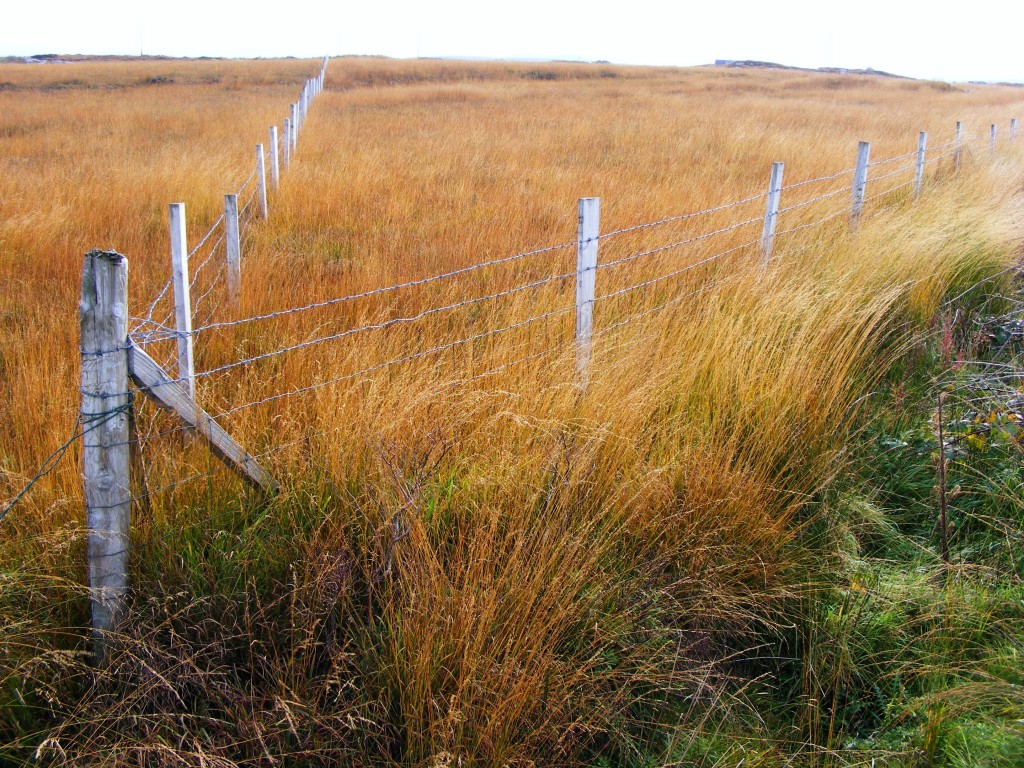
It looks bleached by the sun, not weathered by rain and wind as it has been here on the edges of the Atlantic. I want to go home now and find a sunbeam to sit in with a cup of hot tea and read about landscapes far away and bask in the last of the day.
