Clare Island

(I wrote this piece for the current issue of the Connemara Journal. I have not had much time to post on this blog since the kids got their summer holidays and I apologise in advance, as I expect this will continue until they return at the end of August.)


An unexpected painting commission provided my family and I with a very good reason to visit Clare Island this month. I am ashamed to say that I had never been to the island in the twenty odd years I have lived in this area although I have been told about it’s charms on many occasions. Suffice to say that we were not disappointed.

A little research told us to get to Roonagh pier just outside Louisburgh, where we had a choice of times and ferry operators to make the short crossing. This was the first surprise as the crossing is indeed short – just fiveteen minutes – a bonus for a feeble land lubber such as myself. The second delight was the harbour which is quite idyllic in it’s picturesque sweep of sand and pier. The water was a clear turquoise blue, right up to the pier wall and we were able to admire some large fish and jellyfish over the side of the boat before we disembarked. I don’t think I have ever seen such clean waters in a harbour.


Clare Island harbour

The approach to Clare island harbour


I had made enquires about accommodation and there are several places to choose from. We chose O’Grady’s Guesthouse over looking the beach. We soon discovered that this was the old family homestead of the well known O’Grady family in Clifden, although the current building is completely new. A three minute walk brought us to the front door of Helen and Alan O’Grady’s beautiful stone clad home which conceals bright, spacious rooms worthy of any four star hotel. Helen greeted us warmly and told us about some of the ‘must see’ spots on the island. Our first port of call was the Sailors bar, not for refreshments ( we had those later ) but where we met with our very own Michael Gibbons who was conducting a archaeological tour of the island. This brought us along the coast, where we were entertained with stories of a lost Spanish ship that found itself on a stony shore and the slaughter and tyranny of a different time – quite difficult to imagine in such a tranquil setting. Michael then led us through an ancient wood, buried for thousands of years beneath the bog and now revealed as the knarled and blackened stumps of trees as old as time itself. We left the group about half way along to make a detour to ‘Anna’s Coffee shop’ in anticipation of her ‘famous chocolate cake’ which had been heartily recommended to us. We enjoyed a feast of home made salads and breads in Anna’s garden before retiring inside to enjoy a coffee and a generous slice of her truly delicious cake.

We continued the afternoon in holiday style with a swim at the harbour beach followed by fresh fish and chips at the Sailors bar.

The next day we made time to visit the Abbey, which is about a twenty minute walk from the harbour. This small rectangular building dates from the 12th century and has been beautifully restored and maintained.  Inside, it boasts the best example of rare medieval roof paintings in Ireland. The delicate array of small paintings cover the alter ceiling and depict a variety of mythical, human and animal figures including dragons, stags, birds and trees. There was a professional restorer working on them when we went inside and she pointed out a large relief carving of the O’Malley family crest and the final resting place of the infamous Grace O’Malley which is set into the wall.


SAMSUNG DIGITAL CAMERA

12th century Abbey at Clare Island


We left the island feeling revived and also very impressed with this small community of people who have so carefully and successfully managed their heritage, creating an oasis of tranquillity and hospitality that is hard to match.

Delphi Valley

It’s been too long since my last post as I’ve been caught up in the busyness of life and children. I’m returning with a short post  about a couple of new paintings I’ve just started. These are based on the Delphi valley, which must be one of  the most spectacular views here on the edges of Connemara and County Mayo. I’m working on a couple of canvases at the same time, alternating between the two. This one ( above ) is 10″ x 9.5″  – I’ve kept the palette quite cool so far with lots of blue and green. The second piece below is 10.5″ x 7.5″ and I’ve warmed this one up with some pink.


Delphi Valley with pink road, first stage.


I love this shade of pink – I think it’s everywhere at this time of year, not like this of course but you can see it in a haze over the grasses if you squint your eyes.

I’ll take more photos as these paintings progress and post about them again soon.

June Bog Cotton

Cover photo ‘Cotton and Turf in Connemara’ by Deborah Watkins


The landscape seems to transform itself every couple of weeks in Connemara. Perhaps the most striking feature at the moment is the bog cotton that has sprung up amidst the peat and laid out stacks of turf. This plant seems especially strong this year, perhaps due to the mild weather and also the ash enriched soil following the gorse fires last April. After the fires, these same fields were reduced to a black shadow of charred roots and dirt. I find it remarkable that the same earth can not only renew itself in the space of a year but reinvigorate into an oasis of life and colour.

Bog cotton is a species of sedge which begins to flower in April or May. Fertilisation follows in early summer when it’s small brown and green flowers develop hairy white seed heads that resemble cotton. It can be difficult for the observer to discern from the roadside and the effect is rather like a field of large daisies but on closer inspection, the fluffy cotton heads are unmistakable. Unlike Gossypium cotton from which fabric is derived, this species is unsuited to textile manufacturing. However the plant does have a history of various uses as a cotton substitute – in the production of paper and candlewicks in Germany and as wound dressings in Scotland during World War I.


Bog Cotton close up by Deborah Watkins

Many headed bog cotton by Deborah Watkins


Bog cotton comes in two forms in Ireland – single headed and many headed bog cotton. The two plants are similar in appearance but flourish differently. The many headed bog cotton grows in pools of water – air canals in it’s roots allow air to pass from the surface to the roots in a kind of ‘snorkling’ process. The leaves of this plant are wide with red tips. The single headed bog cotton does not have these air canals. It grows on the drier surface of the bog and it’s leaves are long and needle like to conserve water.


Single headed Bog Cotton

Single headed Bog Cotton by Deborah Watkins


Bog Cotton by Deborah Watkins

Cotton fields of Connemara by Deborah Watkins 


Like many of our indigenous plants in Connemara, the bog cotton is special to this place and this particular time of year. It is also a reminder of the regenerating nature of the earth in even the harshest of conditions.


Gorse – The Colour of Summer

I wrote this piece for the May issue of the Connemara Journal, which will be available shortly.

April brought unexpected heat as well as more predictable showers this year –  a boon of warmth and rain that has resulted in a rush of growth all over Connemara. My own back garden seemed to come alive with colour overnight – new leaves and blossoms swelled in perfect haste, you could almost hear the growth. The gorse transformed itself invisibly from a few scattered flowers into a sea of deep egg yellow that steals a little further every day. Also known as furze, the scent of this impressive plant is subtle but heady, something like the delicate sweetness of coconut. Along with our native fuchsia, it is the shrub that most people associate with this part of the world and it’s hardiness and vivid beauty describe this place like no other. It is also one of our longest flowering plants, coming into it’s own in April (although blooms can be seen much earlier) and lasting right though the summer and into early winter.


Roadside 1

Late summer gorse and heathers at the roadside in Errislannin by Deborah Watkins


It is hard not to miss the gorse in Connemara at the moment, in thick banks along the roadsides and in great mounds and ridges that brighten the landscape. It is closely related to the brooms species of plant and they share similar characteristics with their dense slender stems and very small leaves. Gorse distinguishes itself with it’s sharp thorns ( which can measure up to four centimetres long ) and it’s bright showy flowers are always yellow.


Another photo of gorse

Gorse thorns and blossoms by Deborah Watkins


Gorse has a long history as a fuel because it is easy to burn and it burns very well, reputedly giving off as much heat as charcoal. The ashes it produces are rich in alkali which are very enriching for the soil so it is often burnt down to improve the quality of the land, a practice which is hazardous in dry weather.

Historically, the bark and flowers have been used to produce a yellow dye and gorse flowers have also been used to add flavour and colour to whiskey. In homeopathy the gorse is used as a remedy to give people courage. It’s evergreen leaves and long flowering blossoms are a reminder of the returning sun after short winter days, it’s cheery colour a promise of summer.

Sound of the Sea


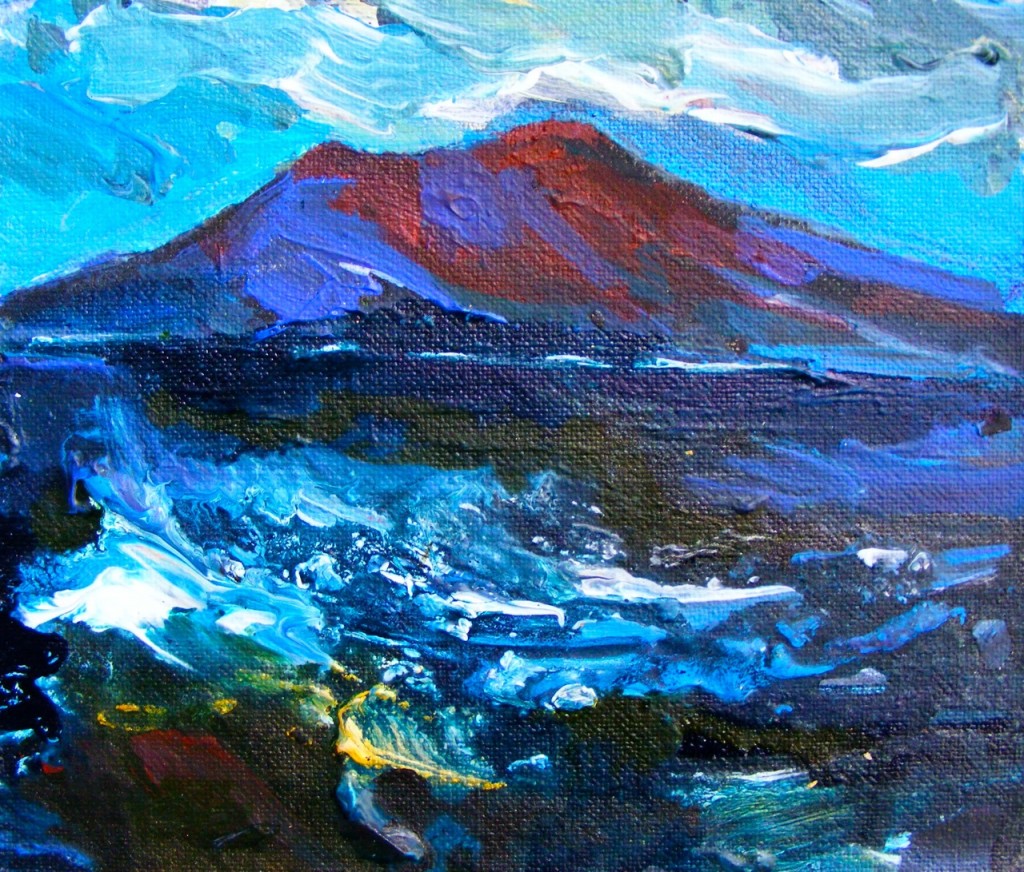
I started a couple of small seascapes last week and instead of working from photographs as I usually do, I painted these from memory with the idea of making images that reflect the darker aspects of the sea, the power and the wildness of it.

I used small canvas boards – ( 6″ x 5″ ) and a combination of acrylic paint and ink. I used a deep red colour on the lower half of the board to give the sea blues more depth and interest. Here’s how the first piece started.


First stage of sea painting


I allowed the paint to dry before continuing. When I looked at it again, it seemed very dull and in need of more paint and colour. I also wanted to inject some movement into the central part of the painting. I started by adding red to the mountains in the distance and I used large brushes to create a wave in the centre of the piece, adding just a little yellow to take the eye down into the depths of the water. The whole thing was worked quite quickly, the idea being to give it a sense of movement and energy. Here’s the finished piece again below.


Finished sea painting


I worked this second seascape at the same time – I find it satisfying to pursue one idea in a few slightly different directions so there similarities. I’ve called this one ‘Sound of the Sea.’


First stage of 'Sound of the Sea'


Once again, I felt it needed more colour and definition – I worked over the mountains and sky and I darkened the sea, using red highlights this time to draw the eye inwards.


Finished painting - 'Sound of the Sea"

Hidden treasure

I realised just before dusk one night last week that one of my hens was still out, so I went searching for her with a torch. She started to make some noise and I followed the sounds, eventually finding her in a cosy little spot in the back hedge. When I reached in to scoop her out, I discovered there were some eggs tucked in behind the undergrowth.


Eggs in the undergrowth


The next morning I went to take a closer look – my hen had hidden herself in a long tunnel, a natural underground passage between the bank and a web of overhanging ivy. I reached in with the camera to take some pictures and then pried back the leaves to gather the eggs – there were sixteen in total!

All those mornings when I’d found no egg in the nest box, I’d assumed that the old girl was having an off day – not thinking for a moment that she had found a nest box of her own!


eggs 3


I disposed of the eggs sadly as I had no way of knowing how long they’d been there. Happy nonetheless to have found her new spot and I’ll make sure to check it on my rounds in the mornings.

Celebrate the Season at Brigit’s Garden

(I’ve written about this place before, one of my favourite places to visit in the West. I’ve recycled it a bit and it will appear again in the next issue of the Connemara Journal.)


Longer, warmer days are here at last. If you are looking for somewhere different to enjoy the Spring air, look no further than Brigit’s Garden in Rosscahill, just outside Galway. If you haven’t been, it’s a must at any time of the year but especially in Spring and early Summer when the wild flowers come into their own. The garden is a not-for-profit organisation and registered charity set up by Jenny Beale out of her passion for nature and the environment.  Designed by Mary Reynolds ( the first Irish person to win a gold medal at the prestigious Chelsea flower show ) it is a ‘natural’ garden in every sense of the word. There are few straight lines – paths curve and wind, circles pop up everywhere  – sunken, interlocking, a tiny moon like island and a great sundial. Wild flowers and grasses, herbs and plants are celebrated in bursts of colour that greet you at every turn.

The design is based on the four Irish seasons – four gardens that interconnect and take you on a voyage through the Irish festivals of Samhain, Imbolc, Bealtaine and Lughnasa. The journey mirrors the cycle of life from conception and birth through to old age and death.

Samhain ( Halloween ) begins on the 31st October and marks the beginning of the cycle. It is celebrated in the Winter garden which pays homage to a time for death, with a promise of re-birth. It is a period of sleep and reflection, evoked by a mound of earth that has been shaped into the sleeping body of a woman, wrapped around a pool. Another figure made of bronze rests on the ground in an island within the pool. She is listening to the earth, waiting for it to stir again and bring forth new life.


Winter garden sculpture in Brigits garden

The bronze woman in the Winter Garden


Imbolc is the Spring garden. This is the old Irish name for the festival now known as St. Brigit’s day. In the garden’s cycle of life it is a place for the young, where children can play and enjoy the basketwork swings and a wildflower meadow.

May day heralds the festival of Bealtaine which is celebrated in the Summer garden. This is a time of young adulthood, sexual awakenings and marriage. The garden tells the story of Diarmuid and Grainne, the fleeing lovers in Irish mythology. Their bed is a grassy hollow facing the sun. A path of standing stones leads to a throne where the lovers unite and sit together.


Photograph of the Summer Garden in Brigit's Garden

The Summer Garden


The Autumn garden marks the festival of Lughnasa which begins in August. It is a time of harvest and celebration. Spiral beds contain herbs for cooking as well as healing. Two circular lawns interlink to create a large space for dancing and a long table provides a picnic area. Three yew trees mark the exit of the Lughnasa garden which signifies the end of the cycle and the possibility of renewal which lies ahead.

There is much more to see – a woodland walk, a living willow play area for children and a wishing tree. You can round off your visit in the cafe which offers a tempting variety of home baked cakes. A treasure of a place, almost on our doorstep and well worth a visit.

Getting some Perspective

I’ve been busy for the last few weeks, doing lots of writing and not very much painting. I’ve been involved in a poetry workshop for over a year now and it’s been great. Writing has slipped into my life so quietly and unexpectedly that I find myself wondering what I did with my time before the workshops. Possibly more painting but life is always a juggling act – for me it’s a question of balance and trying to find just enough time for everything to keep some kind of equilibrium.

At the moment I am writing a business plan for our gallery as we are hoping to develop what we are doing in a new direction. It’s a different kind of writing of course but it is also exciting and I hope that I will be able to share more about that in a few months time.

For now I am going to talk about this painting. I came across it recently while sorting through my desk. I remember working on it about six months ago and leaving it aside as I was unsure whether or not it was finished. Clearly some part of me believed it was not, as it lay quietly unnoticed for all this time. When I found it, I wondered why, because it does seem finished to me now! There are blocks of colour on the right – the pink and green that might seem flat and unresolved compared to the more subtly applied colour to the left, but this gives the piece interest and balance which is something easily lost if the whole surface is treated in the same way.
The negatives seem outweighed by the positives  – there is atmosphere, something moody around that hazy purple, the way the light diffuses in the distance and those stripes of red, pink and green do work even though they are incongruous with the rest of the piece.


Purple Hill


It reminds me how useful and important it is to take some perspective on a painting  – a little distance and time have allowed me to see the piece as if for the first time, so it is easier to make a judgement.

I realise how true this is of writing and yes, so many other aspects in life – it has just taken six months and an old painting to help me remember.

After the Storms – Aillebrack

Today, March 4th was the first day of Spring in Connemara, a month late but let’s not argue now that it’s here ( fingers crossed ).

Homework was abandoned for the afternoon as I took my three daughters to the beach at Aillebrack, near Ballyconneely straight after school. The temperature was a balmy eight degrees but it seemed much warmer – so good to feel some sun after so many months.

I parked the car at Tra Mhor and we walked the full length of the beach which was heavily strewn with seaweed after the storms last month.


Tra Mhor


The defense wall seems to have done its job for the most part although the fence on the top of the dunes was badly damaged.


Fence damage at Tra Mhor


We followed the path beyond Tra Mhor towards the next strand.


The walk between beaches


As we descend onto the beach, there is a lot more visible damage. Large chunks of the coast have fallen in and the area is strewn with rocks.


The descent onto the next strand


Nothing prepares us for the next little cove which has been almost completely covered with rock. A favourite spot, this particular beach was a beautiful white strand before the storms. It is now almost completely covered with large boulders and is almost unrecognisable – where have they all come from?

There is just a small semi circle of rock free sand left.


Rocks at Aillebrack


Looking back from where we have just walked. It is quite a sight as we have spent many afternoons here on what used to be sand. We are thankful nonetheless for the warm, calm weather, a hopeful turning point in the season.


After the storm at Aillebrack


Marie Coyne – Photographer, Genealogist, Poet

Cover image of wild seas at Inishbofin by Marie Coyne


Marie Coyne is a native of Inishbofin off the coast of Cleggan in Connemara. She is an accomplished photographer, a genealogist and a proud custodian of her island heritage. She is also a poet.

Marie has spent all her life on the island and has a long interest in documenting and preserving the old ways of island life. Twenty years ago, Marie set up the Inishbofin Genealogical Project, researching the families of Bofin and the surrounding islands. She began by going from house to house, compiling thousands of names and details on large sheets of paper before bringing it all together on a computer program. It is a living resource which is still being added to and which has circled the globe.

As part of her interest in local history, Marie set up the Inishbofin Heritage Museum in 1998. This is an eclectic mix of everyday items from an old island cottage, some farm and fishing implements and an impressive collection of photographs representing all aspects of island life.

If you have not already discovered Marie through her research, you may well have come across her photographs. A fine photographer, Marie suceeds in capturing the fierce beauty of this place through images that are both artistically eloquent and impressive as records of journalistic importance. She has been exceptionally busy in recent weeks documenting the storm damage on the island that has effected so many. Her photographs have helped to bring the plight of the islanders to the attention of people on the mainland and to local and national politicians and journalists.

The island was hit  dramatically on February 1st, St. Brigid’s day. An unusual combination of severe Atlantic storms and high tides tore away at the East end pier and an old fish curing station which dates from 1897. These before and after photographs taken by Marie show the extent of the destruction.


Damage to East End by Marie Coyne


This powerful storm also effected the north of the island where a narrow stony beach separates Inishbofin Lake from the Atlantic. Lough Bofin is a rare example of  a sedimentary lagoon. The salinity of the lagoon varies as sea water enters by percolation – fresh water enters in large volumes during periods of heavy rainfall. It’s completely natural condition makes it one of the rarest of it’s kind in Europe. The powerful waves caused a serious rupture in the beach opening it up to the ever encroaching Atlantic.


Map of Inishbofin

Map of Inishbofin


Marie’s photographs show the beach before the storm and the extent of the damage afterwards.


Damage to the north Beach by Marie Coyne


The North Beach after the storm


With many Irish towns in turmoil after the floods, the islanders knew that they could not afford to wait for outside assistance. Every available piece of machinery was tracked over to the site and work began on the reconstruction of the beach. Marie recorded their efforts in a series of photos and film footage that document a remarkable reversal of events. Together, this small community succeeded in preserving access between the Middle and North Quarter of the island and protecting this important natural resource for future generations. Marie paid homage to the workers during this process through a series of stunning black and white portraits which make a wonderful collection and will ensure that this event will be remembered and talked about for many years to come.


Mending the north beach by Marie Coyne


PJ by Marie Coyne


Andrew by Marie Coyne


John by Marie Coyne


Lastly, a poem by Marie who is a person of many talents. You can read more of her work and view her extensive collection of photographs by visiting her facebook pages at www.facebook.com/Inishbofin-Genealogy and www.facebook.com/InishbofinHeritageMuseum.


Poem by Marie Coyne


Lone Journey


When the moon got up tonight

she came to my feet

and gently washed her face

in rippling lake water,


She dried herself

with passing white clouds

and set sail for ocean night,


Out there all alone

she is making empty silver roads

I wish I could walk upon.


Poem and photographs reproduced with kind permission by Marie Coyne