Miry Place II

The last time I worked on this painting, it looked like this (below)


Miry Place - beginnings


It sat around for a long while and every so often, I would pick it up and tinker with it, always feeling that it needed something more. Here are some of the stages I brought it through;


Next stage of Miry Place painting


Next stage of Miry Place painting


A further stage of Miry Place painting


During this time, the seasons changed and those bright yellows turned into darker browns. I thought I’d try to reflect this in the piece and to darken the whole painting considerably. Here’s the result below.


Miry Place - finished painting


It’s a far cry from where it started! It has completely lost the freshness it had early on. There was something there at the first stage that really worked – the deep blue and ochre colours against each other especially. Perhaps I should have left it as it was but it did seem to me to have an unfinished air about it. I was very unsatisfied with all these in between stages but I am quite happy with it now in it’s darker form. It does seem to me to reflect the darker hues of the landscape at the moment. What do you think?

Hen Paintings

Horse Study V by Debi O'Hehir

I’ve been working on a couple of hen paintings this week. I haven’t done any for a long while and we sold the last two of mine in the gallery at the week end. The subjects are our own hens and so I started by taking some pictures of them in the back garden. The two red ones are Rhode Island Reds and the grey is a Bluebell. You may remember I wrote about them during the Summer when we found our first egg.

They move around together and often imitate each others exact movements which is amusing to watch, a bit like synchronised swimming. Well not really..


Photo of hens by Deborah Watkins


I especially like the triangular appearance of their bodies when they lean over, it’s such a striking shape.


Photo of two hens by Deborah Watkins


\


Bottoms up girls! I love this pose too as they remind me of ladies in old fashioned bloomers..


Photo of three hens by Deborah Watkins


Here’s how the first painting started. I used a small 4″ x 4″ canvas which I think suits the nature of the subject and also makes for an affordable finished piece.


First stage of bluebell hen painting


Here’s the same piece straight on.


First stage of Bluebell hen painting from another angle


And here’s the finished painting.


I worked this in two sittings. I find the first stage easier as I am mainly concerned with getting the gesture of the hen across. The second stage is always more difficult as I tend to slow down and work more finely to get the detail right. I often find that I lose some of the energy of the pose while doing this.

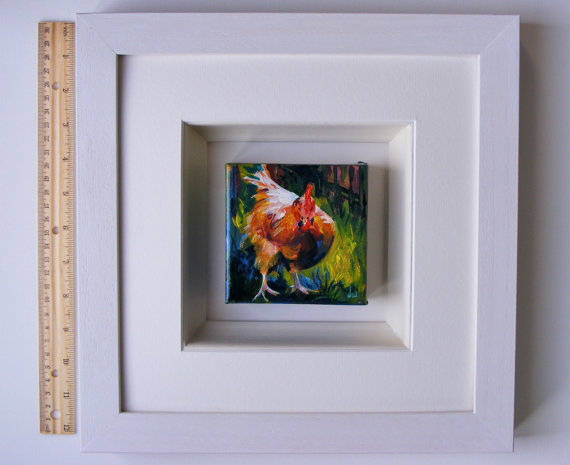
Here’s the start of the second piece. I continue the painting around the sides as you can see. G will frame these in his own hand made box frames which will display all sides of the canvas, like the one underneath this image.


First stage of second hen painting by Deobrah Watkins


Framed hen painting


Here’s the second painting  after some more colour has been added.


Second stage of hen painting


This is the same stage but taken straight on.


Second stage from a different angle


And here’s the finished piece.


Finished hen painting by Deborah Watkins


This one has lost some of the brightness and liveliness it had at the earlier stage but not too much I hope. I find these a completely different experience to painting landscapes – it’s a more direct way of working so I find myself caught up in trying to get a reasonable representation of the subject. I’m less concerned with intangibles like atmosphere or mood. The hens are dear to my heart however as we’ve had the pleasure of owning our own for several years. It’s also something that has had a bit of a revival around the country so I find that people generally react well to the finished paintings.

November Bog

Near Maam by Laureen Marchand


This is another painting in the Black Bog series that I’ve been working on. It’s similar to the last one featured here but it’s twice the size at 10 x 8 inches. This is how it began;


November bog painting first stage


Next, I added a line of brown ink and dragged the colour downwards with a broad brush to give the lower part of the painting an under colour. I also used some gold paint.


Second stage of November bog painting


Here’s the next stage below. I’ve used lots of colour – browns, reds, yellows and golds. I’ve manipulated the way the inks react with the paint to create interesting textures and I’ve worked with a variety of brushes to make different kinds of marks.


Third stage of November bog painting


Once this layer of paint had dried completely, I worked on the piece again (below). I deepened the blues of the hills in the background and I darkened some of the colours to give the painting more contrast.


Fourth stage of November bog painting


This is the finished piece below. Once again, I added more paint and ink when the last layer was completely dry. I altered the line of the bog slightly to make it less horizontal and I’ve given the bog more depth with these additional layers of colour.


Finished 'November Bog' painting by Deborah Watkins

Winter Waits

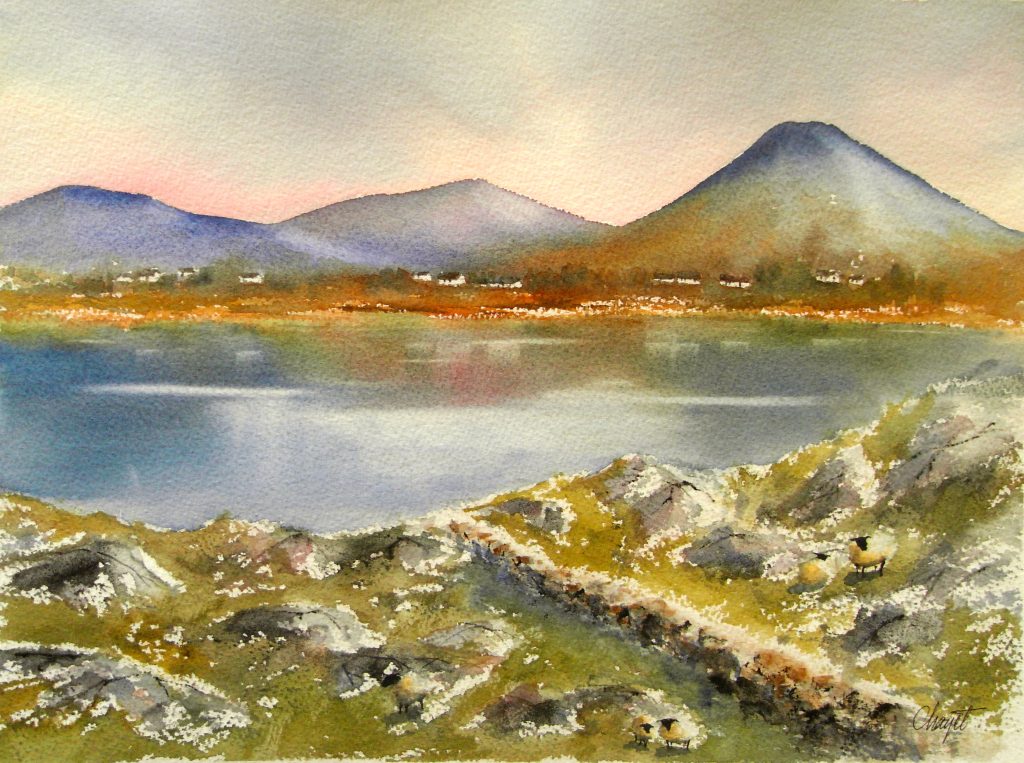
Cashel by Marianne Chayet

The first week of November has come and gone with more dry days than wet. It’s a remarkable thing here in Connemara where the rain is never far away. We feel grateful when we get a whole day of dry weather, even more grateful when we get two in a row. I find an excuse to go outdoors when it’s like this, everything else can wait; housekeeping, book keeping, laundry, shopping, even painting is put on hold. If I’m really organised I’ll put some washing out to dry first thing, so that I can leave guilt free.

I took these photos out on the bog road between Clifden and Roundstone. October’s gold has deepened to these Wintry hues, it’s brown all over and under – russety, chocolatey, chestnut brown. The light is low, shining across rather than above and making the brighter grasses glint like shards of coloured glass or metal.


Brown Bog at Roundstone


The water makes a silvery stripe against the bog and there’s an inky blackness at the edges where the grasses are reflected. It makes me think of a pool of mercury sliding through the landscape.


Photo taken at Roundstone Bog


There’s a stark kind of drama about it all, a bareness from the flat grey light of the sky that seems to muffle colour like sound. I like to track down the words, sometimes a verse to match the way the land looks. That’s how I stumbled across these lines from the poem ‘November‘ by John Payne.  I think they fit the mood well – the setting is an empty stage and there’s more than a hint of darkness in the shadowy figure of Winter, laying in wait.


The tale of wake is told; the stage is bare,

The curtain falls upon the ended play;

November’s fogs arise, to hide away

The withered wrack of that which was so fair. 

Summer is gone to be with things that were.

The sun is fallen from his ancient sway;

The night primaeval trenches on the day:

Without, the Winter waits upon the stair.


taken from ‘November‘ by John Payne ( 1842 – 1916 )

November

November is a difficult month. It’s the shock of losing the hour and the suddenness of it – it always feels more like losing two when overnight it’s dark at 6.00pm instead of 8.00pm. A sixth of the day gone, just like that, slipped out of the day and vanished into the blackness. I think the body reels from it for a while, misses the light without knowing what is the matter or what it is missing. It seems like a starker thing here in Connemara where nature is magnified; bigger spaces, bigger winds, giant silhouettes of mountains and grey days of rain in blustery torrents or invisible misty sheets. It’s taken me a long time to learn an acceptance of this and I have spent too much time resenting the end of the year and fighting the gloom of the approaching Winter with a grumble and a moan.

This changed for me after a trip to Brigit’s Garden just outside Galway city where I began to see the Winter garden sculpture (below) for what it is. This image of the sleeping woman is such a beautiful one. She is so peaceful looking and such a quiet, gentle figure in the space that you want to tiptoe around her for fear her slumber might be disturbed. Unexpectedly, it was she who woke me up to the reality of Winter as a necessary time in the cycle of the seasons. Just as we humans must sleep at the end of the day, the earth needs to rest and recover, to shed it’s leaves and all it’s colour and to sleep, so that it can prepare for new growth ahead. The secret for me was to see this changing time as a human form.


Winter garden sculpture in Brigits garden

 Image taken from Stream


Robert Frost has personified the gloominess we might feel at this time of year in his poem ‘My November Guest’ (below).


My November Guest


My Sorrow, when she’s here with me,

Thinks these dark days of autumn rain

Are beautiful as days can be;

She loves the bare, the withered tree;

She walks the sodden pasture land.


Her pleasure will not let me stay.

She talks and I am fain to list;

She’s glad the birds are gone away,

She’s glad her simple worsted gray

Is silver now with clinging mist.


The desolate, deserted trees,

The faded earth, the heavy sky,

The beauties she so truly sees,

She thinks I have no eye for these,

And vexes me for reasons why.


Not yesterday I learned to know

The love of bare November days

Before the coming of the snow,

But it were vain to tell her so,

And they are better for her praise.


Robert Frost ( 1874 – 1963 )


The humanising of sorrow in this poem lessens it. It is no longer an overwhelming feeling but a human being, a woman who has simply stepped in, although she is uninvited. Frost acknowledges her presence and by doing so he accepts these feelings while he tells of the beauty of Winter, the ‘faded earth’ and the silver ‘clinging mist’. It’s a struggle because she ‘vexes him for reasons why’ but he is listening and seeing nature’s beauty for himself, he has learned to ‘know the love of bare November days.’

As I think perhaps I have too.


Cover image is ‘Harsh Life’ by Inez Streefkerk

Black Bog

Pike by Claire Finlay


This image of Roundstone bog inspired the painting above. It’s unremarkable as a photograph but I love the contrast in it, between the darkness of the boggy landscape and the gem like blues of the mountains and paleness of the sky.


Photograph of Roundstone bog by Deborah Watkins


This is how the painting started below.


First stage of Black bog painting by Deborah Watkins


I started at the top of the page and kept the colours clean when working on the sky and mountain shapes. Then I outlined the line of the land in a dark ink and I dragged some of the colour down using a brush to make a yellowish wash. This is the how the painting developed below.


Black  bog painting by Deobrah Watkins


I worked quickly using a combination of acrylic paint and ink together and brushes of different sizes. I like the way the paint settles when I work quickly like this, some effects are accidental but I have an idea about the overall feeling I want the piece to have. The middle and foreground dominates in this one because the marks are broad and gestural and this contrasts with the relatively careful way the sky and mountains have been painted. The richness of the colours that I have used in the landscape also make it stand out – browns, reds, golds, yellows and some dark blues. I like the way a large brush stroke gives the impression of strata, like layers of matter so the effect is being allowed to see under the earth as well as across it, to see the layers of material that have built up under ground over time.

I’ve decided to call this one finished as I’m happy with the results as they are. I’ll varnish it once the paint has dried and this will give it a protective coating as well as making the colours appear richer, as they were when they were just made and a bit like the way the colour of a beach pebble looks deeper when it is wet.

Sea Week Exhibition 2012

Letterfrack’s annual Sea Week  festival is underway. It’s an exciting programme of events – music workshops, conferences, walks and visual art all of which have the subject of the sea at their core. This annual celebration is running for many years now under the guidance and boundless energy of Leo Hallissey and it is always a welcome opportunity for the community to reflect on the gift of our natural surroundings here in Connemara. Last Saturday night, I went along to the opening of the Small Works exhibition taking place in the Connemara National Park. This year the theme is the ‘Island’ and this exhibition is a collective whereby artists who are living and working in the area are invited to participate. The really interesting thing about this show is that everyone presents their work anonymously. In this way, established artists ( some known on an international scale ) are shown alongside much lesser known artists and the viewer is invited to see each piece on it’s own merit, without partiality or bias. Another distinctive feature of the show is the prices – everything on view is for sale at the agreed price of  €90.00 unframed or  €130.00 framed. This idea of bringing art to the people by making it affordable is supported by all of the artists who allow their work to be shown at a low value and it gives people here the opportunity to buy an original artwork, some perhaps for the first time. Leo introduced the show with this in mind and he spoke about it as a ‘hymn of hope and generosity’ and a ‘reclaiming of values’. These things are worthy of praise, what we are left with really after the shock of the last four years and the excess that went before it.


Where Sea meets Sky by Karina Heaslip

‘Where Sea meets Sky’ 


Music is always an important part of the evening and this year was no exception as we were treated to a number of tunes from young local musicians before Galway city arts officer James Harrold took the floor and officially opened the show. He spoke about the islands in terms of mythology and dreams, as symbols of life and interesting places to explore. He was full of praise for Letterfrack as a thriving community of artists and a place of enormous energy and diversity, characteristics which make this small place shine out among other larger western towns. He also spoke about our unique landscape and coastline, how privileged we are to have the sea at our side and how enriching this is for our community when so many counties are locked in by land.


Detritus of my Studio arranged as an island

‘Detritus of my studio arranged as an Island’


My own first impressions of the exhibition took account of the way it was presented and all credit to the meticulous eye of curator and artist David Keane and painter Mary Hession. The show has a real sense of cohesion in spite of the enormous variety of work and scale, framed and unframed pieces. I recognised some of the artists by their style of painting and drawing and in some cases by their chosen materials. However I was unable to pin down most of the pieces and I really enjoyed the sense of mystery that this brought about and the close examination of each piece that it prompted. I found it inspiring to see such a variety of responses to one theme, like a chorus of quiet separate voices singing together. Some of the pieces can be clearly read as island forms, other paintings suggest it with colours and other imagery. All of them made me look at my own work in a new way and question how I might explore new materials in the future.


Untitled by Alice Coyle

Untitled


Untitled by Colin O Daly

 Untitled


The artists participating in this exhibition are – Barrie Cooke, Margaret Egan, Bernie Dignam, Mary Donnelly, Debbie Watkins, Alice Coyle, Brigid Sealy, Laura Cull, Jill Scott, Angie Williams, Oilbhe Scanell, Gavin Lavelle, Margaret Irwin West, Tania Gray, Mary Hession, David Keane, Leah Beggs, Will O’Kane, Karina Heaslip and Dorothy Cross.

Don’t let this one pass you by, it’s well worth a visit and it runs till October 29th.


Cover image by David Keane

Autumn Gold

I took a trip out to Roundstone village at the week end and took some photos on the way. I travelled on the bog road which is a ribbon of tarmac that twists and bumps across the landscape. It’s spectacular at any time of the year because of the vast expanse of bog and lakes and the backdrop of the Twelve Bens mountains but it is really special in Autumn. The burnt orange colours of the grasses give off a deceptive feeling of heat and all the more striking against the blue of the mountains behind. It’s a combination that makes me think of the outback of Australia, wild and vast and hot.


Photograph of Roundstone bog by Deborah Watkins


There are few trees in this place which is something I miss but this carpet of orange heathers and grasses makes up for it. Shimmering colours against the low sun; yellows, browns, ochres, coppery reds – it’s a fiery mix and a golden time, a pause before the long Winter ahead. When the days are warm like they have been, it’s an extra gift, making long sunbeams indoors and tall shadows outside and unexpected warmth, reminding us to hold on to every balmy moment while we can and to savour it.

These grasses below are on the outskirts of the village.


Golden grasses near Rounstone village by Deborah Watkins


It’s an impressive sight and the land feels alive with movement, like hair or water, the gentle sound of it making a whisper, moving back and forward and around me where I stand. Now I have the notion that I could be in some wild prairie in America, not here in Connemara where it’s green and wet.


More grasses near Roundstone by Deborah Watkins


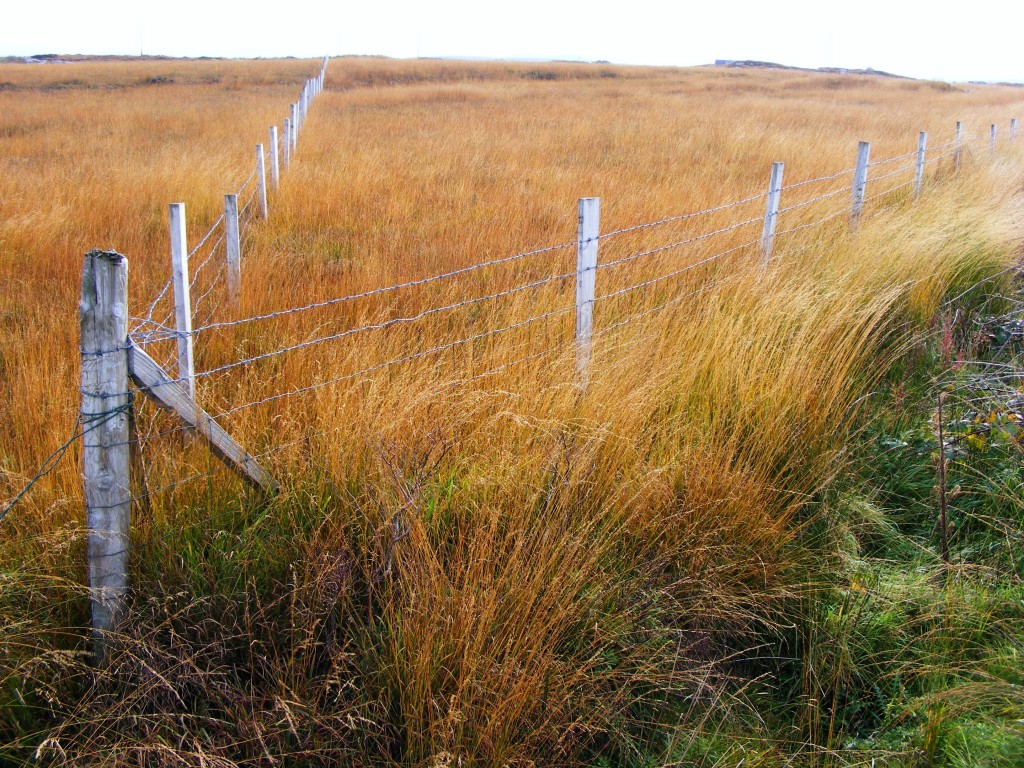
I liked the contrast between the fence and the grasses in this next photo.


Fence and grasses near Roundstone by Deborah Watkins


It looks bleached by the sun, not weathered by rain and wind as it has been here on the edges of the Atlantic. I want to go home now and find a sunbeam to sit in with a cup of hot tea and read about landscapes far away and bask in the last of the day.


Close up of fence by Deborah Watkins

Buttermilk Hill


The picture below is the view from my top window where beyond the back garden, the gorse and the telegraph poles you can see Buttermilk hill.  (You can also see the new hen run – almost finished, the girls playhouse – I leave the bunting out all Winter because it adds some cheer and Jellybean our ginger cat!


Buttermilk hill from my top window


Here’s a better view of the hill (below) from Clifden’s National School. I’ve looked at it from this vantage point many times in the last eight years.. it always makes me think of a sleeping giant, the curves and hollows of a turned away face, it’s nose the highest point.


Buttermilk hill from Clifden National School


In all the time I’ve lived here, I’ve never climbed to the top of the Buttermilk so I made it a project this week and I brought my camera with me. This next photo is taken about half way up. I had to watch my footing as the ground was thick with tufty grasses, gorse and heather.


Halfway up Buttermilk hill


Such a great view already. This northern side of town has shrunk and seems to nestle cosily in the hills and mountains beyond. There’s colour among the russet grasses too and when I look closely, I spot some purple flowers and a brilliant red leafed plant.


Purple plant


Red leafed plant


At last the ‘nose’ of the hill was within reach..


The top of Buttermilk hill


When I got to the top, a plain of land was unveiled ahead and the lakes that provide our house with water.


Lake and grasses on top of Buttermilk hill


The view along the Wesport Road and beyond was wonderful – St. Catherine’s nursing home with its long narrow avenue to the left and the Spire of St.Joseph’s church off to the right. I could pick out my own house and the bright green GAA pitch beyond it. The mountains looked magnificent, their peaks covered in mist and I had the feeling that they were closer at this vantage point even though this is a relatively small hill.


View from Buttermilk hill


View from Buttermilk hill


One last picture looking further north – more clouds in this one and the curling line of Streamstown bay in the far distance.


On top of Buttermilk hill


I was tempted to keep walking but my time was limited so I made a promise to myself to return in the near future.

Blog Awards Ireland 2012

I attended the Grafton Media Blog Awards Ireland as a finalist last Saturday night – I drove up to Dublin on my own on Saturday morning (always  a bit of a treat to have free rein with the radio) and went along to the Osprey hotel in Naas with my parents that evening.

It was a great night and all down to the hard work of Lorna Sixsmith, Beatrice Whelan and Amanda Webb ( above ) and their team who put a lot in to this years awards and the event itself which was packed full of entertainment. We were directed to a beautifully decorated room – balloons aplenty and two giant screens at the front, with a live feed from twitter which was updated every few seconds. I was instructed to make my own name badge with the materials on the table – markers, glitzy stickers and stars while my Dad kindly went to the bar to furnish us with some alcoholic beverages to calm the nerves. A magician came to the table shortly afterwards to entertain us with some slight of hand tricks – this was a great icebreaker and really set the tone for the evening which was high spirits, celebration and fun!  I met a couple of bloggers at our table and got chatting with Holly from Holly’s Pantry ( who kindly took this photo of me and my parents below ) and a very nice couple from The Movie Blog.


Me with my parents at the Irish Blog Awards 2012


Kildare native Susan Boyle was MC for the evening and she got the ball rolling by announcing that we would get our starters after the first ten categories were read out, followed by the next ten and our dinner and so on until the whole thirty winners were awarded their prizes and everyone had been fed and watered. This turned out to be a very good arrangement and with just enough food to quell our appetites, a speedy succession of winners in between and some very speedy speeches. The arts and culture category was the first one to be awarded and I have to say that I was thrilled to be included with all of these finalists whose blogs are of a very high standard. All the names went up on a giant screen and were read out by Susan who then opened an envelope in Acadamy Awards style to announce the winner. I really was delighted that Built Dublin got this award, the best in the category in my opinion and truly deserved. The lifestyle category ( the second one my blog was included in as a finalist ) was read out later and went to A year in Redwood – again tough competition and although I was disappointed, it was a relief to be able to sit back and enjoy the rest of the evening.

So what now for this blogger? To be honest, I feel tired just at the moment as there has been a degree of pressure, knowing that my work has been under the eye of the judges since July this year. I need to take some time to find my feet again and perhaps at a slightly slower pace so that I can unwind over the winter and do some of the other things that I enjoy – knitting and sewing for example, meeting with friends and cooking. This stuff has been sorely neglected since the Summer along with my house which needs a good going over with the hoover and a duster!!

There’s no doubt that I have caught the bug however because blogging is now part of my life and something I genuinely enjoy. Onwards and upwards!


Cover photo taken by Damian Carroll of Cearbhuil Studios