Sound of the Sea


I started a couple of small seascapes last week and instead of working from photographs as I usually do, I painted these from memory with the idea of making images that reflect the darker aspects of the sea, the power and the wildness of it.

I used small canvas boards – ( 6″ x 5″ ) and a combination of acrylic paint and ink. I used a deep red colour on the lower half of the board to give the sea blues more depth and interest. Here’s how the first piece started.


First stage of sea painting


I allowed the paint to dry before continuing. When I looked at it again, it seemed very dull and in need of more paint and colour. I also wanted to inject some movement into the central part of the painting. I started by adding red to the mountains in the distance and I used large brushes to create a wave in the centre of the piece, adding just a little yellow to take the eye down into the depths of the water. The whole thing was worked quite quickly, the idea being to give it a sense of movement and energy. Here’s the finished piece again below.
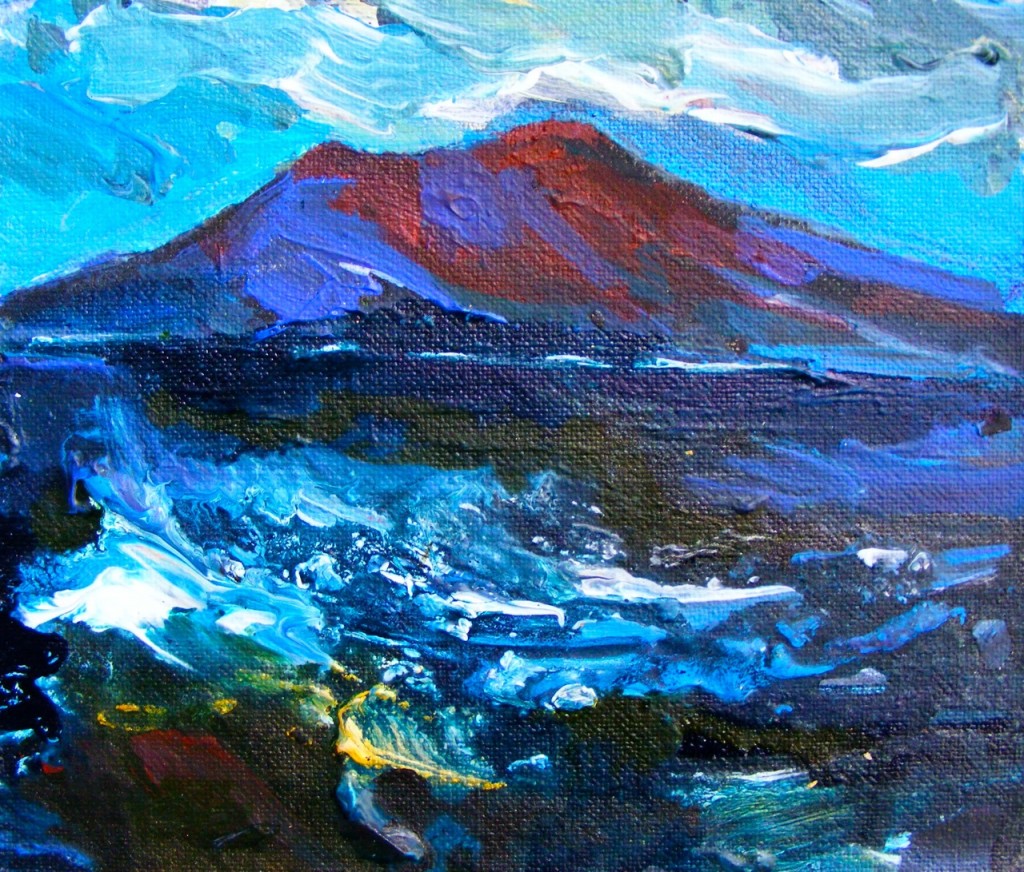
 

Finished sea painting


I worked this second seascape at the same time – I find it satisfying to pursue one idea in a few slightly different directions so there similarities. I’ve called this one ‘Sound of the Sea.’


First stage of 'Sound of the Sea'


Once again, I felt it needed more colour and definition – I worked over the mountains and sky and I darkened the sea, using red highlights this time to draw the eye inwards.


Finished painting - 'Sound of the Sea"

Hidden treasure

I realised just before dusk one night last week that one of my hens was still out, so I went searching for her with a torch. She started to make some noise and I followed the sounds, eventually finding her in a cosy little spot in the back hedge. When I reached in to scoop her out, I discovered there were some eggs tucked in behind the undergrowth.


Eggs in the undergrowth


The next morning I went to take a closer look – my hen had hidden herself in a long tunnel, a natural underground passage between the bank and a web of overhanging ivy. I reached in with the camera to take some pictures and then pried back the leaves to gather the eggs – there were sixteen in total!

All those mornings when I’d found no egg in the nest box, I’d assumed that the old girl was having an off day – not thinking for a moment that she had found a nest box of her own!


eggs 3


I disposed of the eggs sadly as I had no way of knowing how long they’d been there. Happy nonetheless to have found her new spot and I’ll make sure to check it on my rounds in the mornings.

Celebrate the Season at Brigit’s Garden

(I’ve written about this place before, one of my favourite places to visit in the West. I’ve recycled it a bit and it will appear again in the next issue of the Connemara Journal.)


Longer, warmer days are here at last. If you are looking for somewhere different to enjoy the Spring air, look no further than Brigit’s Garden in Rosscahill, just outside Galway. If you haven’t been, it’s a must at any time of the year but especially in Spring and early Summer when the wild flowers come into their own. The garden is a not-for-profit organisation and registered charity set up by Jenny Beale out of her passion for nature and the environment.  Designed by Mary Reynolds ( the first Irish person to win a gold medal at the prestigious Chelsea flower show ) it is a ‘natural’ garden in every sense of the word. There are few straight lines – paths curve and wind, circles pop up everywhere  – sunken, interlocking, a tiny moon like island and a great sundial. Wild flowers and grasses, herbs and plants are celebrated in bursts of colour that greet you at every turn.

The design is based on the four Irish seasons – four gardens that interconnect and take you on a voyage through the Irish festivals of Samhain, Imbolc, Bealtaine and Lughnasa. The journey mirrors the cycle of life from conception and birth through to old age and death.

Samhain ( Halloween ) begins on the 31st October and marks the beginning of the cycle. It is celebrated in the Winter garden which pays homage to a time for death, with a promise of re-birth. It is a period of sleep and reflection, evoked by a mound of earth that has been shaped into the sleeping body of a woman, wrapped around a pool. Another figure made of bronze rests on the ground in an island within the pool. She is listening to the earth, waiting for it to stir again and bring forth new life.


Winter garden sculpture in Brigits garden

The bronze woman in the Winter Garden


Imbolc is the Spring garden. This is the old Irish name for the festival now known as St. Brigit’s day. In the garden’s cycle of life it is a place for the young, where children can play and enjoy the basketwork swings and a wildflower meadow.

May day heralds the festival of Bealtaine which is celebrated in the Summer garden. This is a time of young adulthood, sexual awakenings and marriage. The garden tells the story of Diarmuid and Grainne, the fleeing lovers in Irish mythology. Their bed is a grassy hollow facing the sun. A path of standing stones leads to a throne where the lovers unite and sit together.


Photograph of the Summer Garden in Brigit's Garden

The Summer Garden


The Autumn garden marks the festival of Lughnasa which begins in August. It is a time of harvest and celebration. Spiral beds contain herbs for cooking as well as healing. Two circular lawns interlink to create a large space for dancing and a long table provides a picnic area. Three yew trees mark the exit of the Lughnasa garden which signifies the end of the cycle and the possibility of renewal which lies ahead.

There is much more to see – a woodland walk, a living willow play area for children and a wishing tree. You can round off your visit in the cafe which offers a tempting variety of home baked cakes. A treasure of a place, almost on our doorstep and well worth a visit.

Getting some Perspective

I’ve been busy for the last few weeks, doing lots of writing and not very much painting. I’ve been involved in a poetry workshop for over a year now and it’s been great. Writing has slipped into my life so quietly and unexpectedly that I find myself wondering what I did with my time before the workshops. Possibly more painting but life is always a juggling act – for me it’s a question of balance and trying to find just enough time for everything to keep some kind of equilibrium.

At the moment I am writing a business plan for our gallery as we are hoping to develop what we are doing in a new direction. It’s a different kind of writing of course but it is also exciting and I hope that I will be able to share more about that in a few months time.

For now I am going to talk about this painting. I came across it recently while sorting through my desk. I remember working on it about six months ago and leaving it aside as I was unsure whether or not it was finished. Clearly some part of me believed it was not, as it lay quietly unnoticed for all this time. When I found it, I wondered why, because it does seem finished to me now! There are blocks of colour on the right – the pink and green that might seem flat and unresolved compared to the more subtly applied colour to the left, but this gives the piece interest and balance which is something easily lost if the whole surface is treated in the same way.
The negatives seem outweighed by the positives  – there is atmosphere, something moody around that hazy purple, the way the light diffuses in the distance and those stripes of red, pink and green do work even though they are incongruous with the rest of the piece.


Purple Hill


It reminds me how useful and important it is to take some perspective on a painting  – a little distance and time have allowed me to see the piece as if for the first time, so it is easier to make a judgement.

I realise how true this is of writing and yes, so many other aspects in life – it has just taken six months and an old painting to help me remember.

After the Storms – Aillebrack

Today, March 4th was the first day of Spring in Connemara, a month late but let’s not argue now that it’s here ( fingers crossed ).

Homework was abandoned for the afternoon as I took my three daughters to the beach at Aillebrack, near Ballyconneely straight after school. The temperature was a balmy eight degrees but it seemed much warmer – so good to feel some sun after so many months.

I parked the car at Tra Mhor and we walked the full length of the beach which was heavily strewn with seaweed after the storms last month.


Tra Mhor


The defense wall seems to have done its job for the most part although the fence on the top of the dunes was badly damaged.


Fence damage at Tra Mhor


We followed the path beyond Tra Mhor towards the next strand.


The walk between beaches


As we descend onto the beach, there is a lot more visible damage. Large chunks of the coast have fallen in and the area is strewn with rocks.


The descent onto the next strand


Nothing prepares us for the next little cove which has been almost completely covered with rock. A favourite spot, this particular beach was a beautiful white strand before the storms. It is now almost completely covered with large boulders and is almost unrecognisable – where have they all come from?

There is just a small semi circle of rock free sand left.


Rocks at Aillebrack


Looking back from where we have just walked. It is quite a sight as we have spent many afternoons here on what used to be sand. We are thankful nonetheless for the warm, calm weather, a hopeful turning point in the season.


After the storm at Aillebrack


Marie Coyne – Photographer, Genealogist, Poet

Cover image of wild seas at Inishbofin by Marie Coyne


Marie Coyne is a native of Inishbofin off the coast of Cleggan in Connemara. She is an accomplished photographer, a genealogist and a proud custodian of her island heritage. She is also a poet.

Marie has spent all her life on the island and has a long interest in documenting and preserving the old ways of island life. Twenty years ago, Marie set up the Inishbofin Genealogical Project, researching the families of Bofin and the surrounding islands. She began by going from house to house, compiling thousands of names and details on large sheets of paper before bringing it all together on a computer program. It is a living resource which is still being added to and which has circled the globe.

As part of her interest in local history, Marie set up the Inishbofin Heritage Museum in 1998. This is an eclectic mix of everyday items from an old island cottage, some farm and fishing implements and an impressive collection of photographs representing all aspects of island life.

If you have not already discovered Marie through her research, you may well have come across her photographs. A fine photographer, Marie suceeds in capturing the fierce beauty of this place through images that are both artistically eloquent and impressive as records of journalistic importance. She has been exceptionally busy in recent weeks documenting the storm damage on the island that has effected so many. Her photographs have helped to bring the plight of the islanders to the attention of people on the mainland and to local and national politicians and journalists.

The island was hit  dramatically on February 1st, St. Brigid’s day. An unusual combination of severe Atlantic storms and high tides tore away at the East end pier and an old fish curing station which dates from 1897. These before and after photographs taken by Marie show the extent of the destruction.


Damage to East End by Marie Coyne


This powerful storm also effected the north of the island where a narrow stony beach separates Inishbofin Lake from the Atlantic. Lough Bofin is a rare example of  a sedimentary lagoon. The salinity of the lagoon varies as sea water enters by percolation – fresh water enters in large volumes during periods of heavy rainfall. It’s completely natural condition makes it one of the rarest of it’s kind in Europe. The powerful waves caused a serious rupture in the beach opening it up to the ever encroaching Atlantic.


Map of Inishbofin

Map of Inishbofin


Marie’s photographs show the beach before the storm and the extent of the damage afterwards.


Damage to the north Beach by Marie Coyne


The North Beach after the storm


With many Irish towns in turmoil after the floods, the islanders knew that they could not afford to wait for outside assistance. Every available piece of machinery was tracked over to the site and work began on the reconstruction of the beach. Marie recorded their efforts in a series of photos and film footage that document a remarkable reversal of events. Together, this small community succeeded in preserving access between the Middle and North Quarter of the island and protecting this important natural resource for future generations. Marie paid homage to the workers during this process through a series of stunning black and white portraits which make a wonderful collection and will ensure that this event will be remembered and talked about for many years to come.


Mending the north beach by Marie Coyne


PJ by Marie Coyne


Andrew by Marie Coyne


John by Marie Coyne


Lastly, a poem by Marie who is a person of many talents. You can read more of her work and view her extensive collection of photographs by visiting her facebook pages at www.facebook.com/Inishbofin-Genealogy and www.facebook.com/InishbofinHeritageMuseum.


Poem by Marie Coyne


Lone Journey


When the moon got up tonight

she came to my feet

and gently washed her face

in rippling lake water,


She dried herself

with passing white clouds

and set sail for ocean night,


Out there all alone

she is making empty silver roads

I wish I could walk upon.


Poem and photographs reproduced with kind permission by Marie Coyne

Cut Bog

This painting is slightly more abstract than the previous two. The focus is a uniform well like shape in the foreground in which a pool of water reflects the blue sky. I have simplified a lot of the other shapes – the mountains and the patterns in the land and I’ve been bold with colour.

This is how the painting started – looking back, I think there is a good argument to say I should have stopped here and it’s not the first time I have thought this about my work.


Cut bog - first stage


Here’s the next stage. I’ve added some darker colour to create more contrast and I’ve started working on the grasses to the side of the pool using large brushes and lots of paint.


Cut bog , stage two


This is how it continues, more work on the grasses and I’ve brought back some of the blue in the pool.


Cut Bog - stage three


Here’s the finished piece. I’ve altered the line where the mountains recede from the land and I’ve sharpened up the grass shapes to the right of the pool.

Is this the better painting or should I have called it a day after the first sitting? I would welcome your response to this one.

In the meantime, I need to do some fast smaller works to loosen up my painting again.


Cut Bog, finished painting

Lecknavarna

This is the second painting in a recent series based on the Lecknavarna townland near Killary. Here’s how the painting began – it’s a 12″ x 16″ canvas board.

Blue and red dominate and these are the colours that stood out when I was there. The fiery red is unusual for this time of the year and the effect was accentuated by the low fall of light. The mountains ( the Ben Coonas ) complement with rich tones of blue. I’ve accentuated the depth of hue in this initial sketch and I make a mental note to do some more studies like this soon as there is an immediacy and an energy to the piece at this stage that would work on a smaller scale.


First stage of blue road painting


Here’s the next stage. I’ve used some dark ink on the mountains and I’ve added more detail to the road and middle ground.


Second stage, blue road painting


I work with paint and ink together at this next stage and add some green to the foreground to give it more definintion.


Third stage blue road painting


The mountains have become a little too dark and flat so I attempt to lighten them next.

Next stage, blue road painting


This continues below and at last I feel that the mountains are coming alive. I referred back to the initial sketch to help me achieve this. The paint is still wet when I take this photo.


next stage, blue road painting


This is the same stage but the paint has dried and dulled a little. Once again, this will deepen once the piece is varnished.


Blue Road - finished painting


Return to Painting 2014


I got back to painting this month once the kids returned to school. Armed with some photos taken near Killary, I chose two largish canvas boards ( 12″ x 16″ ) and one stretched canvas ( 12″ x 14″ ) to get started. I have been working on all three paintings over the last few weeks, bringing each of them along in stages. I took photos at the end of each painting session which proved useful as I was able to use the earlier images in some cases to develop the work at a later stage. I have written about each piece separately due to the number of photos – here’s how the first piece began below. I love this initial phase of getting the fresh paint onto the board, there’s a great freedom and an opportunity to be bold with broad sweeps of colour.


Painting first stage


This is the next stage – I’ve used a good deal more paint, working from the top down. I’m happy with the blue mountains and don’t develop these much further.


Painting second stage


The middle ground is next, probably the brightest part of this piece. I’m using ink and allowing it to bleed into the paint in places.


Painting stage 3


Next I start to work on the foreground – it still lacks definition. I want to get across the effect of looking into or through the earth by abstracting this part of the painting so I experiment with some different shapes.


Painting stage 4


I try a few bold upward sweeps using a large brush and some gold and white – I also use inks ( blues and reds ) through the paint. I decide to leave it at this stage.


Painting stage 5


The paint is dry in this final photo. The colours have dulled a little but these will be lifted again once the piece has been varnished.


Last stage Connemara Loop Painting

Killary

I took some photos along the roadside near Killary with a view to using them for some new paintings. I took these because certain elements attracted me – colours, the shape of the mountains in silhouette and the shape of the cut bog. I like this one below because of the warmth of the orange grasses against the blue sky – feels more like Australia than Connemara.


Hill near Killary


The light is still very low and it illuminates each blade of grass much like theatre lights. There is great drama too in the starkness of the mountains – they loom in the distance, great shadowy figures waiting in the wings.

This is a protected area so there are few signs of human interference save the ubiquitous telegraph poles and the road itself. You feel like you are standing in a bowl or an amphitheatre with mountains on almost all sides. I love the blue pool in this one below – it reflects the colour of the sky.


Killary


I have started a series of new landscapes based on these images which I will post about soon.