Stratton Mountain Tragedy

Cover image ‘Stopping by the Woods on a Snowy Evening’ by Follow The Raven 


I’ve been thinking about including this song somewhere on the blog for quite a while. It’s based on a poem written by Seba Smith in 1843 and collected by Helen Hartness Flanders in the 1930’s. I came to know it when I discovered the writing and music of Robin McArthur and I never fail to be touched by the words. It seems to me to be a fitting piece to include here on the brink of Christmas as a tale of love and loss and ultimately survival in Wintertime.

It’s a true story about a woman called Lucy Blake and her daughter Rebecca who got lost on Stratton Mountain in Vermont during a snowstorm in 1821. Writer and musician Robin McArthur is also a native of Vermont and she and her husband Tyler Gibbons form the band ‘Red Heart the Ticker.’ They have recorded ‘Stratton Mountain Tragedy’ in their album ‘Your name in Secret I would Write’. In an article in the arts website ‘Gwarlingo‘, Robin tells how she sang this song at the Marlboro historical society and how people there contributed their knowledge of the story. One woman said that every Spring she visits the cemetery where Lucy Blake is buried and noticed there was a red rose on her grave. She later found out that Lucy Blake’s ancestor still lives in town and puts a rose on the grave every Mothers day. Extraordinary how history can be brought to life and made real again through story and song – words and music connecting people through time and across generations.

These are the words.


Stratton Mountain Tradgedy


Cold was the mountain’s height

Drear was the pasture wild

As through the darkness of the night

A mother wandered with her child

As through the drifting snow she pressed

The babe was sleeping ‘neath her breast.


Bitter blew the chilly winds

Darker hours of night came on

Deeper grew the drifting snow

Her limbs were chilled, her strength was gone

‘Oh God,’ she cried in accents wild

‘If I must perish, save my child’


She took the mantle from her breast

Bared her bosom to the storm

As round the babe she wrapped the vest

She smiled to think that it was warm

One cold kiss, one tear she shed

And sank into that snowy bed


A stranger passing by next day

Spied her ‘neath the snowy veil

The frost of death was in her eye

Her cheek was hard and cold and pale

He took the robe from off the child

The babe looked up and sweetly smiled.


Seba Smith ( 1792 – 1868 )


Click on this link below to hear the song.


Stratton Mountain Tragedy’ by Red Heart The Ticker


I wish you all a happy and a peaceful Christmas and I’ll be back to you again sometime in January.

Deborah

Hen Paintings in Progress

Here’s a couple of hen paintings I’ve been working on. They are at various stages of completion. The one above is the one I’m most happy with but it’s not quite finished yet. Here’s how it began below.


First stage of hen painting


Here it is after a bit of work.


Second stage of hen painting


and after a little more work.


Third stage of hen painting


Just a small bit of detail needed, not too much or it will become fussy. Here’s two more paintings as they progressed.


Second hen painting - first stage


Second hen painting - second stage


Second hen painting - finished


Third hen painting - first stage


Third hen painting - second stage


Third hen painting - finished


I’ve overdone this one a bit and it is fussy – I still find it hard to get that balance right, between a lightness of touch – enough to express the movement and energy of these creatures with enough detail to justify calling it a painting ( not just a sketch ) but not so much that they become fussy and drained of energy and life. Still learning.

Maybe time for just one more post before Christmas, I have something seasonal in mind and then a couple of weeks of rest, glorious rest – school holidays and lies ins and rest. Lovely.

Still Painting

Still painting yes, but still using a roller and a very large bucket of matt white emulsion. I’d love to be one of those people who can manage more than one major project ( ie: painting the house and some other stuff as well – like the other kind of painting ) but sadly I am not and frankly it’s a wonder that the family haven’t starved and/or run out of clothes as this task has been truly all consuming. On the positive side though, the house has never looked better. Unseen corners that haven’t been noticed for years are emerging and EVERYTHING looks brighter – there’s a lot to be said for ‘Brilliant white’! I have had the occasional splurge of colour like this green wall (below) in my kitchen which I love. We have prints and paintings here that we have bought/collected and swapped over the past fiveteen fifteen years or so. The toaster sketch is by our friend Joyce Tansey and the Coffee Pot is by Blaise Smith. The print under the Toaster is by Kathe Kollwitz and the landscapes are by good friend and talented painter Mary Donnelly. The Little Trees drawing is by canadian artist Luke Ramsey. I love them all.


and just look at those shiny white skirting boards and that sparkly architrave – I do feel proud!

Here’s a bit of red in the front room below.


Red wall in my sitting room


I love red and also have some in my kitchen. The fabric in the blind came from Ikea – out of date now. I still treasure it even though it’s a bit faded. There’s ‘Jellybean’ our ginger cat outside on the window sill..


Ikea fabric blind in my kitchen


I’m almost there, just another coat of gloss in the hall and that’s the downstairs done. Upstairs can wait till after Christmas..

Soon back to painting on canvas then – I’ve a couple of hen paintings that need to be finished which I’ll post about in a little while.


Winter Cleaning

Seafarer by Claire Finlay

I’ve been busy doing lots of this kind of painting below


Photograph of decorators ladder and paint tins


..and not so much of the other.

It’s a spring cleaning kind of thing that I’m going through but for us this has to happen in Winter as there’s no time in Summer when the gallery is busy. Our poor house has been sorely neglected for a good many years and so I’ve been painting walls and ceilings and skirting boards and architraves and bookshelves and window sills.. It’s time consuming and addictive because once you start in on one corner you have to take pictures down and clean them and then maybe change them around or replace them. Then you go looking for new photos or older ones and before you know it, the morning has gone!

I found a photograph of this painting while doing just that. It’s one of my early seascapes, from about 2009. It’s most likely based on the sea out at Aughrus which is a beautiful coastal area near Claddaghduff, just a few miles north of Clifden. I was using a lot more charcoal as you can see in the background of this piece. I often cringe at older work but it was nice to come across this one and I’d be happy enough with it if I produced it today. So forgive me if the posts are a little threadbare while I do this nesting cleaning tidying thing and I’ll be back soon.


Wild Sea by Deborah Watkins


Ballinafad

I drove to Galway city on Wednesday morning, a hundred mile round trip from Clifden town. It’s a journey I make about once a month and usually out of necessity when I have a sufficient amount of errands to run. This particular morning was beautiful – crisp  and sunny and still. Fortunately I had my camera with me so I was able to pull in at Ballinafad and take some pictures. You might think that I’ve photoshopped these but it’s the real thing and exactly as it was ( I’m not a great fan of photoshop, especially when it comes to landscape ). This is the N59 looking towards Galway with ‘Lissoughter’ and ‘Binn Ramhar’ mountains on the left.


The N59 Road towards Galway


Here’s the road looking back towards Clifden with the lower slopes of Benn Lettery on the right and Ballinahinch Lake to the left.


N59 Road looking back towards Clifden


And here’s the view south west taking in the lake and forest beyond.


Photo of Connemara in November


Facing south now and some gorgeous reflections in the lake which was as clear and still as glass – the posts supporting the new saplings, the tree line of the forest and the fisherman’s beats outside this little shed. I love the grasses too, golden like burnt caramel and warm to the eye.


Another view of Ballinahinch Lake


I find myself marveling at it all and the fact that I live in such a beautiful part of the country. I think back to the first time I took this road about twenty years ago and the thoughts that ran through my head. It was like going deeper and deeper in to the unknown, into a kind of wilderness. The water almost touches the road in places as it twists and turns around the lakes ( much narrower then ) and I remember finding this a bit unnerving. The remoteness of the landscape, which seemed to recede in to itself further and further was more than a little daunting for a city girl like me but the extraordinary beauty of the place was unmistakable. You might imagine that you would get used to it, stop seeing it perhaps and begin to take it all for granted but this simply isn’t true. Every season brings a change and each season has it’s own special kind of beauty and moments like these in Ballinafad are made for savouring.


One last photo of Ballinafad

Other Landscapes

I’ve just bought a book by poet Bruce Snider based on a couple of poems by him that I discovered on the Gwarlingo website. The thing that drew me to them straight away were the vivid descriptions of his hometown of Paradise, Indiana. I was struck by the way he uses landscape as a means of expression and also as a powerful kind of grounding force to that expression. The poems are rich with descriptions of the land, it’s trees and highways, ditches and rivers and these are woven with moments from the past so that somehow he makes these intensely personal experiences into something more accessible, something more universal that we can all understand.

The suicide of the writers cousin ‘Nick’ is at the centre of the collection, simply titled ‘Paradise, Indiana’ but the poems are never indulgent or sentimental. He manages to convey the weight of human grief and loss in a few carefully chosen words that create vivid flashes of imagery, his landscape acting as a kind of compass for memory as he seeks to make sense of the inexplicable.

I especially like this one, called ‘Epitaph’. The images are by Connemara based photographer and hill walking guide Inez Streefkerk.


Epitaph


Because I could be written anywhere,

I loved the hard surface of the blade,

my name carved into barn doors, desktops,

the peeled face of a shag-bark hickory.

I pressed my whole weight into it, letters


grooved deep as the empty

field rows along Tri-Lakes* where I’d seen

my cousin Nick buried in ground so hard

they had to heat the dirt with lamps

before they could dig. I gutted squirrels


my grandmother fried, hanging

skins from the window,

and with the same knife gouged a B

at the base of the frozen creek bank,

the season breaking


like the rose our teacher, Miss Jane,

dipped in nitrogen so it would shatter.

There were more atoms, she claimed,

in the letter O, than people in the entire state.

I could feel God inside that letter,


the vast sky configured, buds scrawled

on the black limbs of trees.

Trucks carried spring feed down

Highway 9 as I wove through the headstones,

tracing names in the late frost,


looking for Nick’s plot

with the wax white roses,

his lucky fishing lure. I could sense

him down there, satin-lined,

curled like the six-toed cat


we’d found bloated in the creek, alive

with lice and maggots. Sometimes

I was sure I could hear him, restless,

waiting for me, the Wabash*

pushing its icy waters, my tongue


humming with the fizz. It never ended,

that stretch of road snaking back home

like an artery through my own heart

where an owl gripped a rat in its claw

over I-80*. I’d put my hands in my pockets


and walk, dreaming of the places I’d go,

the things I’d do, the dump rising

to meet me at the edge of town,

chrome bumpers twisted as the owner

himself, withered arm swinging a fist.


I waited for something to escape –

mouse darting from a glove box, oil

from a cracked sump. I could stand

on a crushed Chevy, feeling it all

thaw inside me: asphalt


and barbed wire, cows and steaming

pails of milk, even the graveyard

rising, new stones nursing old griefs,

slow bones and winter’s cherry trees

making their long walk to leaf.


taken from ‘Paradise, Indiana’ by Bruce Snider


Twisted Oak by Inez Streefkerk

 ‘Twisted Oak’ by Inez Streefkerk

Cover image ‘Birch Bark’ by Inez Streefkerk


*Tri-Lakes

*Wabash

* I-80

Miry Place II

The last time I worked on this painting, it looked like this (below)


Miry Place - beginnings


It sat around for a long while and every so often, I would pick it up and tinker with it, always feeling that it needed something more. Here are some of the stages I brought it through;


Next stage of Miry Place painting


Next stage of Miry Place painting


A further stage of Miry Place painting


During this time, the seasons changed and those bright yellows turned into darker browns. I thought I’d try to reflect this in the piece and to darken the whole painting considerably. Here’s the result below.


Miry Place - finished painting


It’s a far cry from where it started! It has completely lost the freshness it had early on. There was something there at the first stage that really worked – the deep blue and ochre colours against each other especially. Perhaps I should have left it as it was but it did seem to me to have an unfinished air about it. I was very unsatisfied with all these in between stages but I am quite happy with it now in it’s darker form. It does seem to me to reflect the darker hues of the landscape at the moment. What do you think?

Hen Paintings

Horse Study V by Debi O'Hehir

I’ve been working on a couple of hen paintings this week. I haven’t done any for a long while and we sold the last two of mine in the gallery at the week end. The subjects are our own hens and so I started by taking some pictures of them in the back garden. The two red ones are Rhode Island Reds and the grey is a Bluebell. You may remember I wrote about them during the Summer when we found our first egg.

They move around together and often imitate each others exact movements which is amusing to watch, a bit like synchronised swimming. Well not really..


Photo of hens by Deborah Watkins


I especially like the triangular appearance of their bodies when they lean over, it’s such a striking shape.


Photo of two hens by Deborah Watkins


\


Bottoms up girls! I love this pose too as they remind me of ladies in old fashioned bloomers..


Photo of three hens by Deborah Watkins


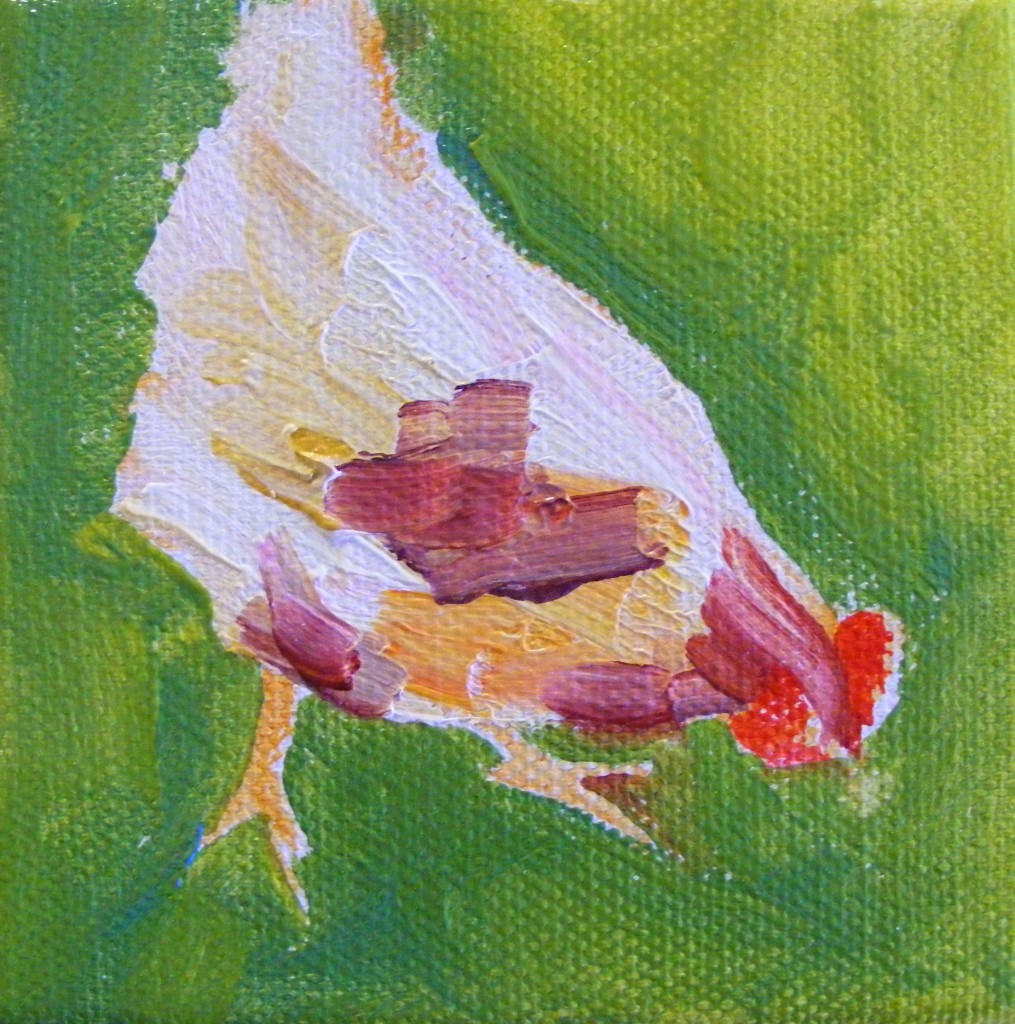
Here’s how the first painting started. I used a small 4″ x 4″ canvas which I think suits the nature of the subject and also makes for an affordable finished piece.


First stage of bluebell hen painting


Here’s the same piece straight on.


First stage of Bluebell hen painting from another angle


And here’s the finished painting.


I worked this in two sittings. I find the first stage easier as I am mainly concerned with getting the gesture of the hen across. The second stage is always more difficult as I tend to slow down and work more finely to get the detail right. I often find that I lose some of the energy of the pose while doing this.

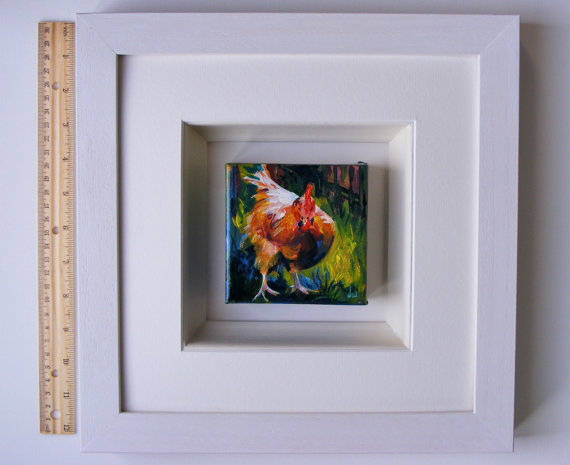
Here’s the start of the second piece. I continue the painting around the sides as you can see. G will frame these in his own hand made box frames which will display all sides of the canvas, like the one underneath this image.


First stage of second hen painting by Deobrah Watkins


Framed hen painting


Here’s the second painting  after some more colour has been added.


Second stage of hen painting


This is the same stage but taken straight on.


Second stage from a different angle


And here’s the finished piece.


Finished hen painting by Deborah Watkins


This one has lost some of the brightness and liveliness it had at the earlier stage but not too much I hope. I find these a completely different experience to painting landscapes – it’s a more direct way of working so I find myself caught up in trying to get a reasonable representation of the subject. I’m less concerned with intangibles like atmosphere or mood. The hens are dear to my heart however as we’ve had the pleasure of owning our own for several years. It’s also something that has had a bit of a revival around the country so I find that people generally react well to the finished paintings.

November Bog

Near Maam by Laureen Marchand


This is another painting in the Black Bog series that I’ve been working on. It’s similar to the last one featured here but it’s twice the size at 10 x 8 inches. This is how it began;


November bog painting first stage


Next, I added a line of brown ink and dragged the colour downwards with a broad brush to give the lower part of the painting an under colour. I also used some gold paint.


Second stage of November bog painting


Here’s the next stage below. I’ve used lots of colour – browns, reds, yellows and golds. I’ve manipulated the way the inks react with the paint to create interesting textures and I’ve worked with a variety of brushes to make different kinds of marks.


Third stage of November bog painting


Once this layer of paint had dried completely, I worked on the piece again (below). I deepened the blues of the hills in the background and I darkened some of the colours to give the painting more contrast.


Fourth stage of November bog painting


This is the finished piece below. Once again, I added more paint and ink when the last layer was completely dry. I altered the line of the bog slightly to make it less horizontal and I’ve given the bog more depth with these additional layers of colour.


Finished 'November Bog' painting by Deborah Watkins