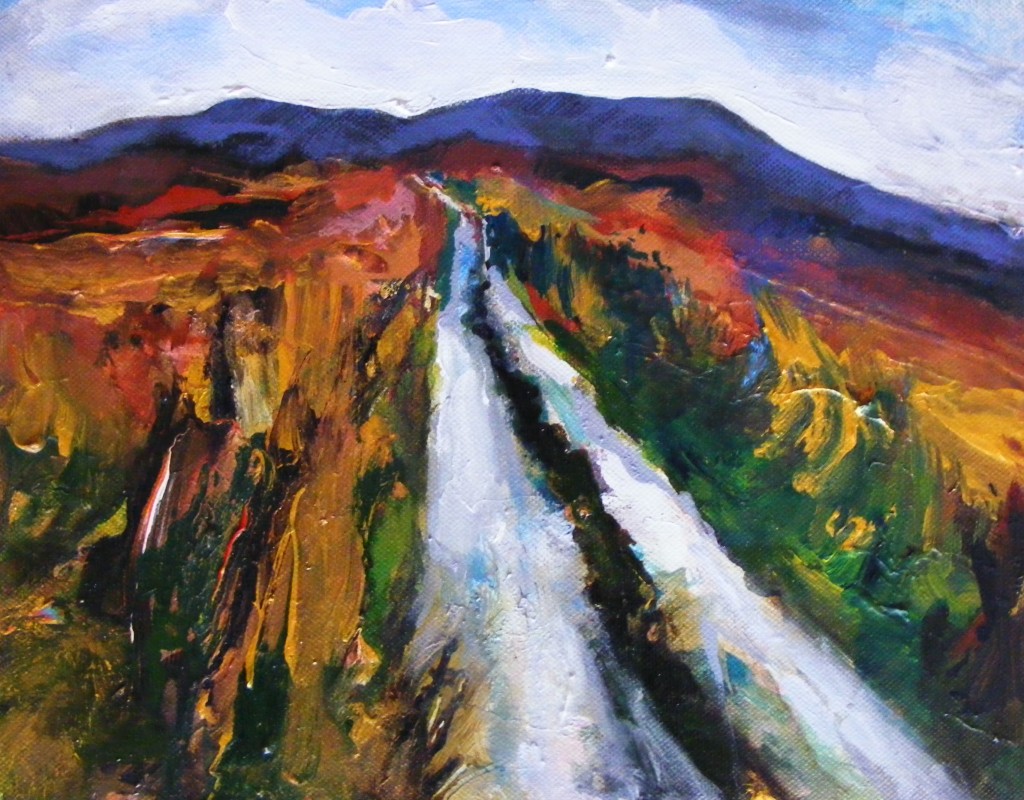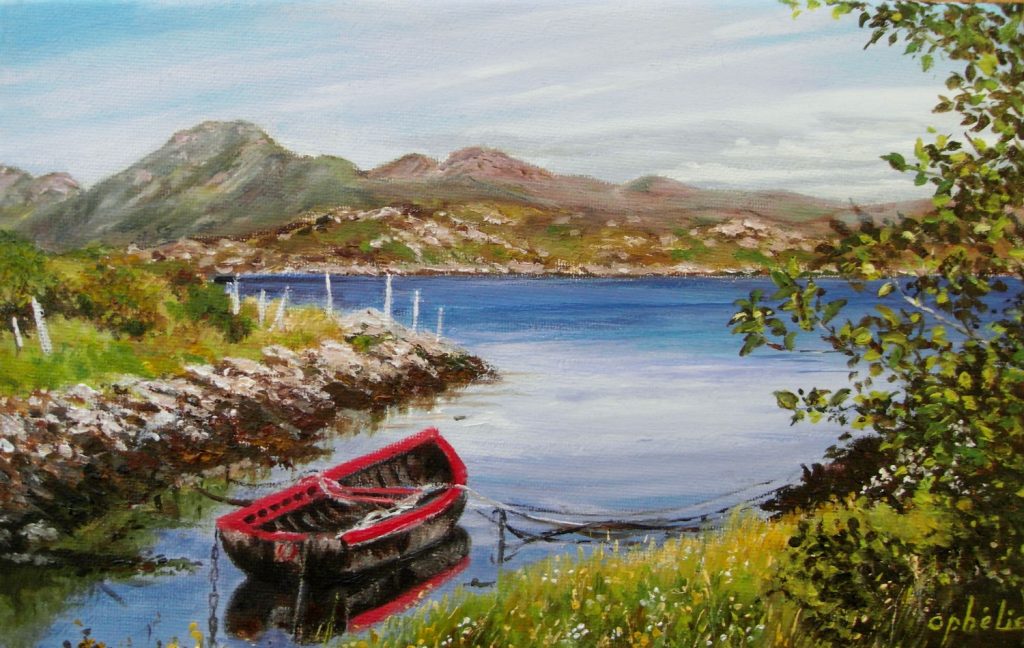
Texture

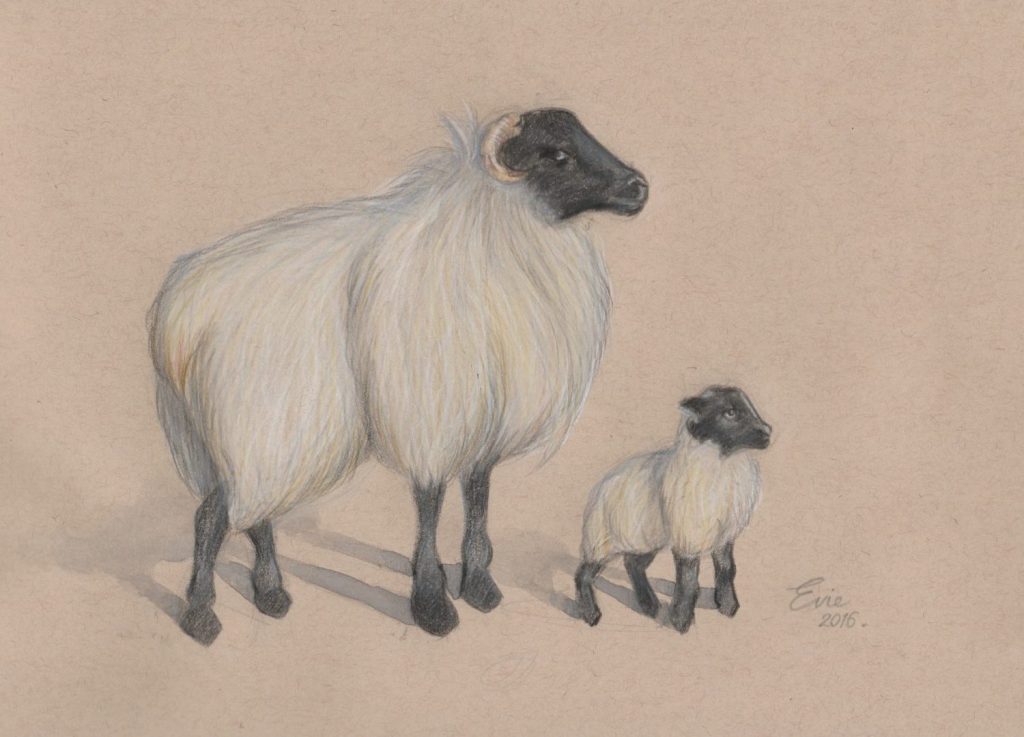
Connemara Sheep by Evie Lavelle

I’ve been working on this large landscape. It’s 12″ x 14″ x 2″ which is a large deep canvas by my standards. It began this below.


First stage of Large Textured Landscape


Then I added more colour.


Second stage of Textured Landscape


Next I brushed on some textured paste, my first time using this medium. It has the consistency of thick paint and is opaque white in colour. I worked into the paste once it was on the canvas to created different kinds of textures. It should probably be applied before this much paint has been put on to the canvas but I wanted to make the textures relevant to what is happening in the painting. I have a pet hate for landscape art that uses texture randomly.


Large canvas with texture


Here’s some close ups below.


Close up of texture medium on canvas


Second close up


Next I added more paint.


Next stage of landscape painting


Here’s the piece after a more work (below).  I’ve covered the canvas with colour now and I’ve made this corner on the left darker than I’d originally planned. I’ve also added some green and brown to the pool as I wanted it to have a more murky feel to it.


Finished painting


When I looked back at the last two images, I saw that I had removed most of the green from the clump of grasses on the front right of the canvas so I went back and put some more green back in there.


Landscape with a little more green


I’ve learnt a few things making this painting – the first is that I love working with this textured paste. It brings the piece alive for me by – a bit like modeling with clay ( ahh, I remember those days ). More than that, I’ve learnt to trust this material ( paint ) which probably sounds a bit strange or perhaps too obvious but sometimes the hardest things to grasp are the things that are right in front of our noses! It’s an acceptance of the material and the ability to really work with it, to just go for it without trepidation. I think I’m finally learning to do this and I feel happy with the way the work is progressing at the moment.


Contrast

I started this one with a couple of others recently. It’s loosely based on some pictures I took out on the bog road this month. I think this one is all about contrast – between the black bog and the white/golden grasses, the darkness of the earth itself and the lightness and blueness of the sky and its reflections.

Here’s how it started below.


First stage of January Bog


Here’s how it progressed – I worked this whole piece very wet, playing with the inks and paint and trying to work with their fluid qualities. I love the way they react together, bleeding into each other like glazes fusing in a kiln.


Second stage of January Bog


I’m almost tempted to leave it as it is ( above ) but I go back to it once the colours have dried. I try to put in just a bit more detail and to describe the grasses a bit better and give them more direction..


Finished Landscape - January Bog


While I am quite happy with this one, I almost prefer it at the earlier first stage as pictured above – what do you think?


January Bog

I drove to Galway yesterday and stopped on the way to take some photos just outside Oughterard. It’s a favourite spot of mine – I took some photographs there last Summer. It’s a different place in January but no less beautiful and in fact there’s still a real richness to the colours of the bog and grasses, lovely russety browns and mahogany shades..


Oughterard Bog, second photo


There was very little colour in the sky and this is reflected in the pools of water which have a metallic quality, like liquid silver or mercury. A lovely contrast against the earthy mix of colours around it.


ough 5


Oughterard Bog - photo by Deborah Watkins


There’s a quietness about the place, a stillness, as if the earth still rests. I imagine tiny tendrils underneath, waiting to move upwards and change this place again with a wash of green. Soon..


Oughterard Bog from the N59

January Landscape

I started another landscape based on some photos of the bog I took in the rain this month. I began the piece on the easel and used charcoal and broad brushes with lots of colour – below.


Landscape first stage


The horizontal swipe of orange made me think of Egon Shiele‘s work – something about the combination of black and rust. I had to stop and take a look at his paintings – this one’s called ‘Truth Unveiled

I love the energy in the lines, the scratchiness of them, you can almost feel the hand that made these marks – the daubs and blocks of vivid colour. Wonderful.


Egon Schiele - Truth Unveiled

 Image taken from canvasreplicsa.com


Now back to work! I added more colour and detail to the landscape below, it’s still on the easel so the inks and paint run downwards a bit.


The same landscape with more paint added


I take it off the easel now and do some work on the table, trying to counteract the vertical lines with more horizontal shapes of colour.


Same landscape worked a bit more


I want to darken it a little now so I use some charcoal where the paint is dry, on the hills at the back especially and in the line through the middle of the road.


Next stage of landscape painting


I mark in the fence on the left also with charcoal.


Landscape after more work


I reworked much of the piece ( below) once the paint was dry. The fence is gone and I’ve decided to leave it out. I tried consciously to avoid being precious about what I’d already done, pushing myself to just go ahead and make mistakes – keeping the image of the place in my mind at all times.

I think this is where my greatest weakness is and I’m trying to gain the confidence to finish a painting with the same energy that it had when it began. I’m happier with the results so far and I need to put this painting away now for a few days and come back to it afresh.


Finished Landscape


Irish Folk Furniture


This beautiful Irish film is debuting at the 2013 Sundance Film Festival and is available to watch on YouTube. It’s an animated documentary short directed by Tony Donoghue and was it funded by the Irish Film Board, RTE and the Arts Council. It charts the restoration of sixteen pieces of traditional Irish furniture from the forgotten dusty corners of old sheds back into the homes where they once held pride of place. The film which runs just under nine minutes, took three years to make – the furniture took several months to dry out before it could be worked on and the outdoor animation was often problematic due to the vagaries of the Irish weather.

In an interview ‘Road to Sundance 2013,’ Donoghue described the film as a piece of ‘pro furniture propaganda: an attempt to show the beauty and social significance of this rural furniture’. He talks about the inspiration for the film as the desire to investigate the discarding of furniture that had been part of families for up to 150 years. He found that there is a strong historical association between these old pieces and general hard times but he also talks about the love of the people and their stories – ‘ I was shocked by the beauty of the personal histories associated with every single item.’

It’s a gem of a film and lets hope it gets the success it deserves at Sundance.


http://www.youtube.com/watch?v=KrfDAIqn6KE


Return to Painting

It’s always hard to get back to painting after a break. I’ve had a couple of false starts since Christmas but I have resolved to try to develop the work in a number of ways. I want to make some larger work this year for one and I also want to make my painting looser, less busy, and more expressive somehow. Yes, quite the tall order I have for myself indeed. This will all take time and it’s frustrating to begin with clear ideas like these in mind and then to find that it’s not so easy to translate into something actual straight away. It’s a process of course and it will take time.

So, here’s how my first painting for 2013 began – it’s really more of a sketch because it’s on quite a lightweight paper.  It’s similar to some bog paintings I made at the end of last year although this was not my intention exactly. I used an easel for the initial part of the painting in an effort to keep the composition loose and energetic.


First stage of painting


Now for some more paint..


Second stage of painting


I’m still using the easel at this next stage but I’m finding that the ink is dripping vertically ( of course! ) which is not necessarily where I want it to go.


Third stage of painting


I finish it on the table and I darken the whole piece with more brown and blue. I discover about now that if I use any more paint or ink the page will dissolve in front of me so this is my main reason for stopping!  I’m reasonably satisfied with it at this stage in any case – my problem with it is that it does seem a bit of a muddle in terms of composition. I like the colours and the diagonal thrust of it but it did seem to work better earlier on. What’s your view?  I think I’ve more work to do..


Fourth stage of painting


And then came the Sun

Derryinver, Connemara by Renee Plantureux

Yes! We’ve had our second dry day in a row. In a row! Great cause for celebration and excitement after the last few weeks of non stop rain. Our poor hens have been trudging around in the swamp that used to be our garden looking very bedraggled and forlorn. I can detect a spring in their step to day which is catching..

Yesterday I left the breakfast dishes in the sink I was so keen to get outside and enjoy the sun. I went to visit a friend in Moyard, a small townland nearby and I stopped on the Bog road ( above ) to take some pictures en route. It’s near the spot where I took the blurry rain shots in a recent post, just a little further along the road. Here’s some more photos – just look at that blue sky below!


Blue skies over the Bog Road


I remember taking some pictures not far from here last January and the sky was a similar bright blue colour. It’s striking when you see it reflected in the water pools as you can see in these next images.


Blue reflections on the bog


Blue Pool in the bog


I love the blackness of these turf stacks in the next shots, I suppose due to the fact that they are sodden with water.


Black turf stack


Just look at this next one, it’s more like black iron or lava than turf..


Close up of turf stack

Proserpina

Cover image ‘Proserpine’ by Dante Gabriel Rosetti taken from Lankaart


I came across this song recently and loved the story behind it. ‘Proserpina’ was written by the late Kate McGarrigle and is performed by her daughter Martha Wainwright. It recalls the ancient Roman myth which tells of the birth of Winter.

One day when Proserpina, the daughter of Ceres – the Goddess of agriculture – was gathering flowers, she was abducted by Pluto, God of the Underworld and carried off to his kingdom. Ceres was consumed with grief and in her anger she scorched the earth, rendering the seeds useless and preventing new growth. Jupiter was forced to intervene and negotiate a compromise. He proposed that as long as Proserpina had not eaten anything while in the Underworld, then she would be set free. Pluto had however offered her part of a pomegranate, which she accepted. She could not be released but an agreement was reached whereby she would spend part of the year in the Underworld  ( Winter ) and part of the year with her mother ( Summer ). When Proserpina is with Pluto the earth is cold and barren and when she returns to her mother, Ceres enriches the earth with her blessings of warmth and growth to welcome her beloved daughter home.

I love the romance of this story and the notion of the forces of nature as the will of the Gods, cursing and charming the Earth with their powers. It’s a soft wrath we have here in Connemara compared to other climates and what a lovely thought it is to imagine the rain as the lament of Ceres as so beautifully portrayed in this song.


Proserpina


Proserpina, Proserpina, come home to momma, come home to momma

Proserpina, Proserpina, come home to mother, come home to momma now

I shall punish the Earth, I shall turn down the heat

I shall take away every morsel to eat

I shall turn every field into stone

Where I walk crying alone


Crying for

Proserpina, Proserpina, come home to momma, come home to momma now

Proserpina, Proserpina go home to your mother, go home to Hera

Proserpina, Proserpina go home to your mother, go home to Hera now

She has punished the Earth, she has turned down the heat

She has taken away every morsel to eat

She has turned every field into stone

Where she walks crying alone


Crying for

Proserpina, Proserpina, come home to momma, come home to momma

Proserpina, Proserprina, come home to momma, come home to momma now

She has turned every field into stone

Where she walks crying alone

Proserpina, Proserpina, come home to momma, come home to momma

Proserpina, Proserpina, come home to momma, come home to momma now


Kate McGarrigle ( 1946 – 2010 )


Rain, Rain

With friends at Clifden Library

This Christmas was one of the mildest and wettest in my recent memory. We’ve had almost three weeks of rain now. I’m struggling to remember a rain free day in that time. G tells me it was fine on New Years Day and I can’t figure out how I missed it! Must have had my head in a book when the sun came out! I took these photos at the week end out on the Bog road to Moyard. It was pouring rain at the time, had been raining since early morning and there was a thick mist hanging low and covering everything in the middle and far distance save for a haze of trees and telegraph poles. Several of the images are blurred due to drops landing on the lens. I quite like the some of  the results though. There’s a drama about them, a romance that I would love to be able to translate in to paint. Here’s some more blurry shots.


Wet day in Connemara


Rain on Bog Road


Fence on rainy day in Connemara


Wet Bog in the rain

Stratton Mountain Tragedy

Cover image ‘Stopping by the Woods on a Snowy Evening’ by Follow The Raven 


I’ve been thinking about including this song somewhere on the blog for quite a while. It’s based on a poem written by Seba Smith in 1843 and collected by Helen Hartness Flanders in the 1930’s. I came to know it when I discovered the writing and music of Robin McArthur and I never fail to be touched by the words. It seems to me to be a fitting piece to include here on the brink of Christmas as a tale of love and loss and ultimately survival in Wintertime.

It’s a true story about a woman called Lucy Blake and her daughter Rebecca who got lost on Stratton Mountain in Vermont during a snowstorm in 1821. Writer and musician Robin McArthur is also a native of Vermont and she and her husband Tyler Gibbons form the band ‘Red Heart the Ticker.’ They have recorded ‘Stratton Mountain Tragedy’ in their album ‘Your name in Secret I would Write’. In an article in the arts website ‘Gwarlingo‘, Robin tells how she sang this song at the Marlboro historical society and how people there contributed their knowledge of the story. One woman said that every Spring she visits the cemetery where Lucy Blake is buried and noticed there was a red rose on her grave. She later found out that Lucy Blake’s ancestor still lives in town and puts a rose on the grave every Mothers day. Extraordinary how history can be brought to life and made real again through story and song – words and music connecting people through time and across generations.

These are the words.


Stratton Mountain Tradgedy


Cold was the mountain’s height

Drear was the pasture wild

As through the darkness of the night

A mother wandered with her child

As through the drifting snow she pressed

The babe was sleeping ‘neath her breast.


Bitter blew the chilly winds

Darker hours of night came on

Deeper grew the drifting snow

Her limbs were chilled, her strength was gone

‘Oh God,’ she cried in accents wild

‘If I must perish, save my child’


She took the mantle from her breast

Bared her bosom to the storm

As round the babe she wrapped the vest

She smiled to think that it was warm

One cold kiss, one tear she shed

And sank into that snowy bed


A stranger passing by next day

Spied her ‘neath the snowy veil

The frost of death was in her eye

Her cheek was hard and cold and pale

He took the robe from off the child

The babe looked up and sweetly smiled.


Seba Smith ( 1792 – 1868 )


Click on this link below to hear the song.


Stratton Mountain Tragedy’ by Red Heart The Ticker


I wish you all a happy and a peaceful Christmas and I’ll be back to you again sometime in January.

Deborah